How a simple side project grew into one of the internet’s most successful curiosity-driven shopping websites—and what creators can still learn from it today.
At a Glance
| Metric | Public Information / Peak Estimate |
|---|---|
| Founded | 2011 |
| Founder | Adam Freedman |
| Peak Affiliate Revenue | $20,000+ per month* |
| Primary Revenue Source | Amazon Associates (~66%) |
| Secondary Revenue Source | Google AdSense (~30%) |
| Estimated Monthly Unique Visitors | 2–3 million** |
| Estimated Monthly Pageviews | 10–15 million** |
| Business Model | Affiliate Marketing + Display Advertising |
Based on a published Nichehacks case study rather than official financial statements.
Traffic figures are informed industry estimates, as This Is Why I’m Broke has never publicly released its analytics.
Introduction
What if someone told you that a website could generate more than $20,000 a month without designing a single product, holding any inventory or shipping a single package?
No warehouse. No customer support. No manufacturing.
Just a website filled with strange things that people never planned to buy.
That website is This Is Why I’m Broke.
For millions of internet users, it wasn’t simply another affiliate website. It was a place to get lost.
One click might lead to a floating bonsai tree. The next to a life-sized dinosaur costume. Then a coffee table built around a classic arcade machine, a lamp that looked like the Moon, or an absurdly expensive luxury item that nobody genuinely needed—but almost everyone wanted to share.
Visitors rarely arrived with a shopping list. Most came looking for nothing in particular and stayed because every scroll revealed something unexpected.
That browsing experience became the website’s greatest product.
At a time when most affiliate websites competed by answering questions like “What’s the best office chair?” or “Which camera should I buy?”, This Is Why I’m Broke chose a completely different strategy. Instead of solving existing buying problems, it created new ones. Rather than targeting purchase intent, it captured curiosity.
That simple shift transformed an ordinary affiliate business into one of the internet’s most recognisable destinations for weird products. But the success of unusual products is not accidental. Humans have always been fascinated by objects that break expectations, challenge normality, or create a feeling of discovery. This psychological attraction to unusual objects is what makes curiosity-driven products so powerful.
At its peak, industry case studies estimated that the website generated more than $20,000 in monthly affiliate commissions, attracted an estimated 2 to 3 million unique visitors every month, and produced as many as 10 to 15 million monthly pageviews during major shopping seasons. Those numbers are particularly remarkable because the company wasn’t backed by venture capital, a large editorial team or proprietary technology. It grew primarily through thoughtful curation, memorable branding and products people genuinely wanted to share.
Perhaps the most surprising part of the story is that the products themselves weren’t always what generated the money.
Founder Adam Freedman later revealed that Amazon accounted for roughly two-thirds of the site’s revenue, yet more than 80% of Amazon purchases were not the featured products visitors originally clicked on. People might arrive to admire a bizarre gadget, then leave Amazon with books, headphones or everyday household essentials. The strange product earned the click; Amazon earned the sale. This is why weird products sell in ways traditional products often cannot.
That single insight explains far more than the success of This Is Why I’m Broke. It reveals how curiosity itself became a business model.
In this case study, we’ll examine how a hobby project evolved into a full-time business, break down exactly how the website generated its revenue, explore the psychology behind its extraordinary popularity, and ask whether a website like This Is Why I’m Broke could still be built in today’s AI-driven internet.
The internet has transformed this curiosity into a new way of discovering products. Today, countless websites are built around unusual objects, strange inventions, and unexpected finds. These platforms have created a new category of online shopping based on curiosity rather than necessity.
Explore our guide to the best weird product websites and discover the online stores where curiosity drives discovery.
The Website Behind the Numbers
A website generating more than $20,000 a month in affiliate commissions naturally attracts attention, but the numbers alone don’t explain why This Is Why I’m Broke became one of the internet’s most recognisable shopping destinations. Plenty of affiliate websites have produced impressive revenue over the years, yet very few have remained memorable long after their peak. What makes This Is Why I’m Broke worth studying is not simply how much money it earned, but the distinctive experience it created for millions of visitors.
Founded in 2011 by Adam Freedman, the website did not operate like a traditional online store. It never manufactured products, managed inventory or fulfilled customer orders. Instead, it curated an ever-changing collection of unusual products sourced from retailers across the internet, earning affiliate commissions whenever readers clicked through and completed qualifying purchases. From a business perspective, the model was relatively straightforward. From a user perspective, however, it felt entirely different.
Most e-commerce websites begin with intent. A visitor searches for a new desk lamp, a gaming keyboard or a coffee maker because they have already decided to buy one. The role of the website is simply to help them compare options and complete a purchase as efficiently as possible.
This Is Why I’m Broke reversed that process.
People rarely arrived because they wanted a floating bonsai tree or a transparent kayak. They visited because they enjoyed discovering objects they had never imagined existed.
This behaviour is not unique to online shopping. Humans have always been attracted to objects that challenge expectations, create surprise or offer a sense of discovery. We explore this psychology in more detail in our article about why weird objects become meaningful parts of our lives.
That distinction shaped every aspect of the website’s design. Rather than publishing lengthy buying guides or exhaustive product comparisons, the homepage presented a carefully curated stream of visual discoveries. Each product occupied just enough space to spark interest without overwhelming the reader with information. A large image captured attention, a concise description provided context, and a single click opened the door to another unexpected find. The experience felt less like browsing a catalogue and more like wandering through a modern cabinet of curiosities, where every scroll promised another surprise.
The approach also produced unusually strong engagement. While the company has never released official analytics, industry estimates suggest that, during its peak years, This Is Why I’m Broke attracted between 2 and 3 million monthly unique visitors and generated as many as 10 to 15 million pageviews during major shopping seasons. Those figures are particularly impressive for a business that relied primarily on affiliate marketing and display advertising rather than proprietary products or subscription revenue.
Understanding those numbers is important because they reveal what the business actually sold. Those numbers reveal a deeper advantage: the website had created a habit rather than a transaction. Visitors returned not because they needed a specific product, but because they trusted the site to consistently surprise them. Every design decision, every product description and every category encouraged visitors to continue exploring, transforming what could have been a simple affiliate catalogue into a destination people returned to repeatedly, even when they had no immediate intention of buying anything. More importantly, this behaviour created a repeat-visit loop: each surprising product increased the chance that visitors would return for another discovery later.
From Hobby Project to a Full-Time Business
Every successful website has an origin story, but This Is Why I’m Broke did not begin with venture capital, a carefully written business plan or the ambition to build a large e-commerce company. Like many of the internet’s most enduring projects, it started as an experiment.
Founder Adam Freedman launched the site in 2011 as a personal side project, driven by a simple observation: the web was full of fascinating products, yet discovering them often depended on luck. Traditional online stores were designed to help people find something they already wanted, while search engines rewarded specific intent. If you knew exactly what you were looking for, the internet worked remarkably well. If you simply wanted to be surprised, however, there were very few places built for that experience.
This Is Why I’m Broke attempted to fill that gap.
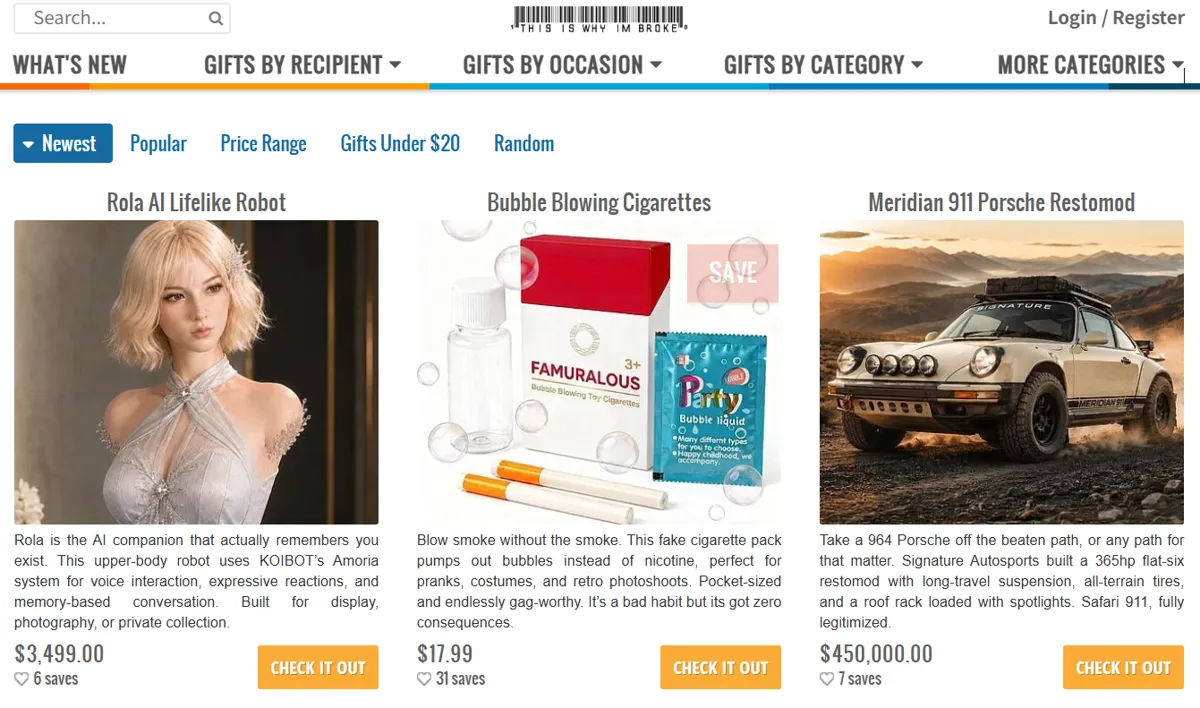
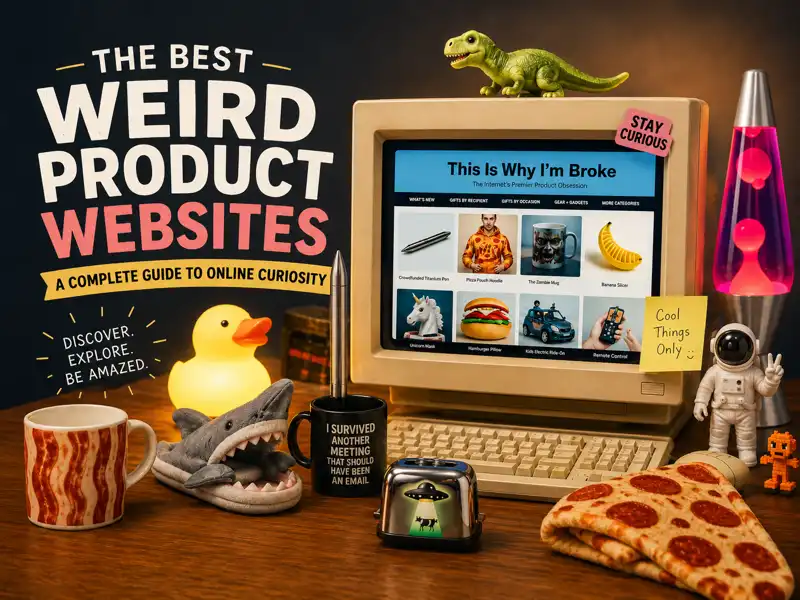
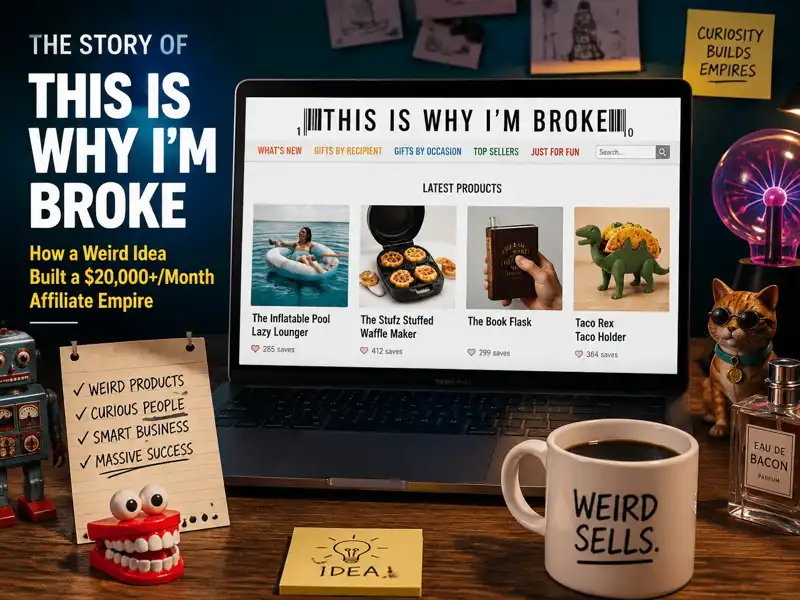
The homepage of This Is Why I’m Broke presents an endless stream of unusual products designed to encourage curiosity-driven browsing.
Rather than organising products around practical needs, Freedman focused on collecting objects that immediately captured attention. Some were ingenious inventions, others were beautifully designed everyday items, and many were unapologetically strange. The goal was never to build the largest product catalogue on the internet, but to create one that consistently rewarded curiosity. Every visit should feel as though a friend had spent hours searching the web and returned with only the most interesting discoveries.
The website’s name reflected that philosophy perfectly. This Is Why I’m Broke was more than a memorable domain; it was an explanation of the experience visitors were about to have. Every unusual gadget, beautifully crafted piece of furniture or outrageously expensive luxury item became another reason to joke about spending money they had never intended to spend. The name was humorous, instantly understandable and remarkably easy to remember, giving the brand an identity that spread almost as naturally as the products themselves.
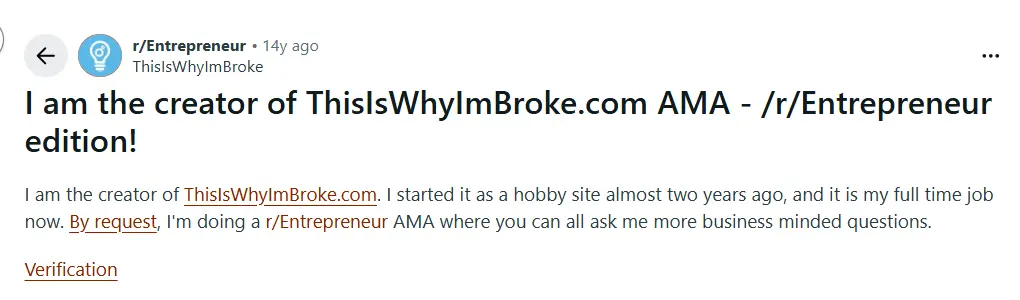
What began as a hobby soon developed into something much larger. In a Reddit AMA published after the site’s rapid growth, Freedman explained that he had started This Is Why I’m Broke as “a hobby site” and that, within less than two years, it had become his full-time occupation. That transition was significant not only because it demonstrated the commercial potential of affiliate marketing, but also because it showed that careful curation could become a business in its own right.
Unlike many affiliate publishers of the period, Freedman did not attempt to produce hundreds of SEO-focused articles or dominate search results for highly competitive product keywords. Instead, he invested his time in discovering products that people genuinely enjoyed looking at and sharing with friends. The website grew because visitors returned repeatedly, not because they needed another buying guide, but because they trusted the site to show them something they had never seen before.
Looking back, the timing could hardly have been better. Pinterest was beginning to transform visual discovery, Reddit communities regularly propelled unusual products into viral discussions, and Facebook had become an important channel for sharing content that entertained as much as it informed. This Is Why I’m Broke was built for exactly that kind of internet. Long before algorithmic recommendation feeds dominated online shopping, the site had already recognised that curiosity could be a stronger habit than purchase intent.
By the time the project evolved into a full-time business, its foundations had already been established. It had a memorable brand, a loyal audience and a browsing experience unlike that of conventional e-commerce websites. The next challenge was no longer attracting visitors—it was turning millions of curious clicks into a sustainable business, a challenge that This Is Why I’m Broke solved through one of the most effective affiliate models of its era.
How a Weird Product Website Generated More Than $20,000 a Month
By the time This Is Why I’m Broke had established itself as one of the internet’s best-known destinations for weird products, the obvious question was no longer why people enjoyed browsing the site. It was how a business built around quirky gadgets and novelty gifts could generate more than $20,000 a month without creating a single product of its own.
The answer wasn’t hidden in a sophisticated technology stack or an unusually generous affiliate program. It came from a deceptively simple insight: the website wasn’t really selling products—it was selling attention.
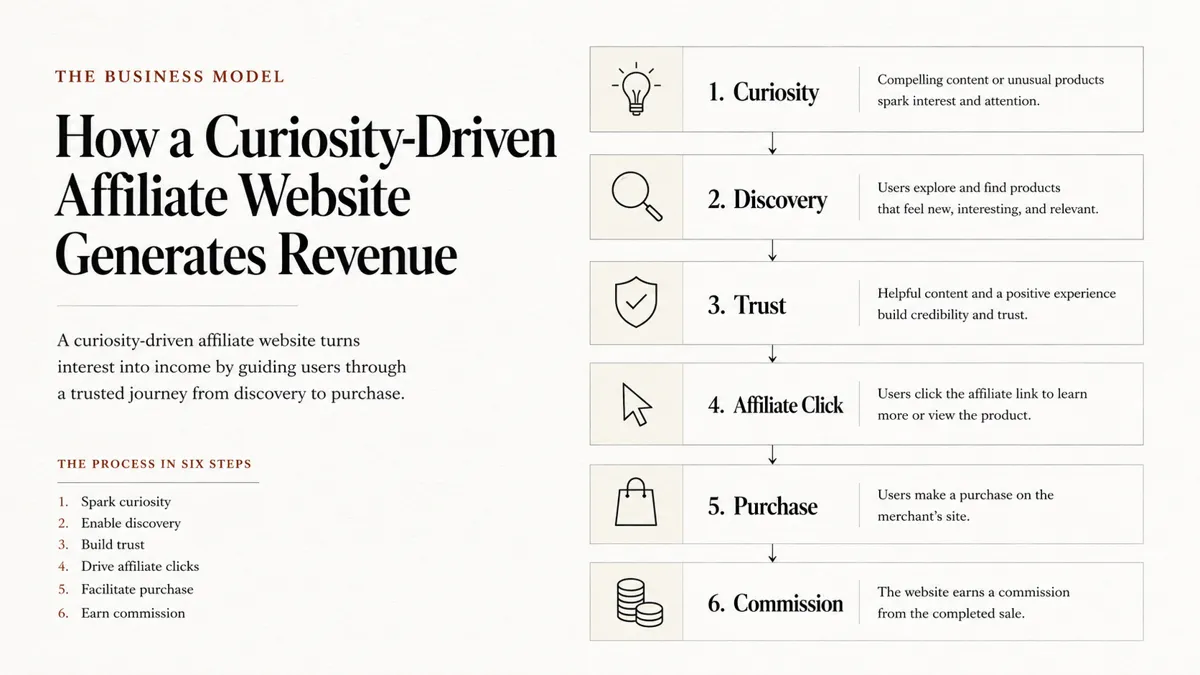
At first glance, most readers assume the business worked in a straightforward way: visitors saw an unusual product, clicked through to Amazon, bought that product and the website earned a commission. In reality, that assumption was wrong.
Freedman revealed that more than 80 percent of Amazon purchases were not the products originally featured on This Is Why I’m Broke.
Someone might click a levitating flower pot, a miniature arcade cabinet or a life-sized dinosaur costume simply because it was entertaining. Once they arrived on Amazon, however, their shopping behaviour changed. They searched for books, replaced household essentials, ordered headphones or bought gifts they had already planned to purchase. The featured product captured attention; Amazon completed the transaction.
That distinction fundamentally changed the economics of the business.
Instead of relying on thousands of expensive impulse purchases, This Is Why I’m Broke focused on generating qualified clicks. Every curious visitor entering Amazon represented an opportunity, regardless of whether they bought the featured item or something entirely unrelated. In effect, the website specialised in creating the first step of the shopping journey, while Amazon’s enormous product catalogue handled everything that followed.
The site’s revenue reflected that relationship. During his AMA, Freedman explained that approximately two-thirds of total income came from Amazon Associates, making it by far the company’s most important revenue source. Google AdSense contributed roughly 30 percent, while the remaining income came from smaller affiliate partnerships and advertising arrangements.
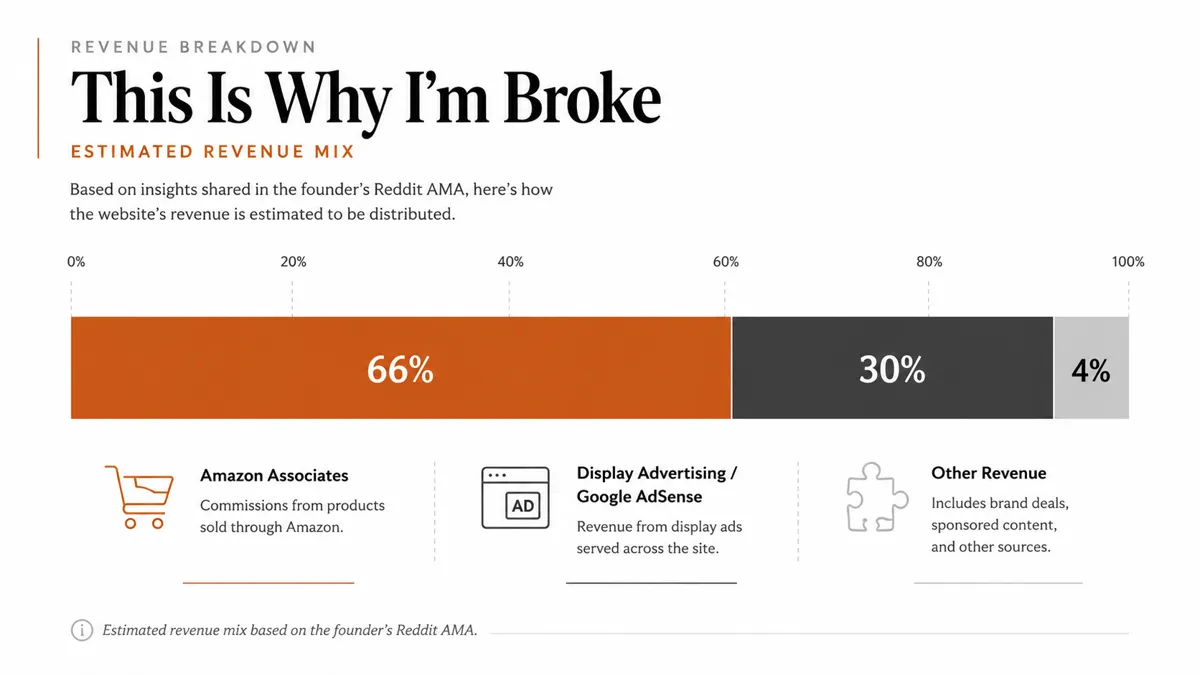
This balance reveals another reason the business proved so resilient. Visitors who clicked through to Amazon generated affiliate opportunities, while those who simply enjoyed browsing still produced advertising revenue. Whether someone arrived ready to shop or simply looking for five minutes of entertainment, the website had a way to monetise their attention.
Scale amplified everything.
Although This Is Why I’m Broke has never released official traffic statistics, industry estimates suggest that the site attracted between two and three million monthly unique visitors during its strongest years. Thanks to its highly visual layout and infinite-scrolling interface, seasonal pageviews were likely to exceed 10 million, with Black Friday and the Christmas shopping season driving even higher engagement.
At that level of traffic, extraordinary conversion rates were no longer necessary. Even if only a small percentage of visitors clicked through to Amazon, the absolute number of outbound clicks was substantial. Once those visitors entered Amazon’s ecosystem, millions of additional products—not just the ones featured on the site—became potential sources of commission.
Perhaps the most remarkable aspect of the business model is how little of it depended on physical commerce. This Is Why I’m Broke never managed inventory, negotiated shipping rates or handled customer support. Its competitive advantage was editorial rather than operational. Every day, the site’s job was to discover products that made people stop scrolling, click for a closer look and continue exploring.
In hindsight, the company was never competing with online retailers.
It was competing for attention.
That is an important distinction, because attention scales differently from inventory. A warehouse grows one shelf at a time, but a compelling discovery can spread across Reddit, Pinterest or Facebook in a matter of hours. By consistently turning curiosity into clicks, and clicks into affiliate revenue, This Is Why I’m Broke built a business that looked like an online store but behaved much more like a digital media company.
Understanding that difference is essential to understanding the site’s success. The affiliate links, advertising partnerships and revenue shares were all accessible to competitors. What could not be copied nearly as easily was the ability to earn attention, day after day, by giving people something genuinely interesting to discover.
Why This Is Why I’m Broke Worked When Thousands of Copycats Failed
Looking back, it is tempting to believe that This Is Why I’m Broke succeeded because it entered the market early. Timing certainly helped, but it does not explain why so many competitors with nearly identical business models failed to achieve the same level of recognition.
After the site’s rapid rise, dozens—perhaps hundreds—of websites adopted a similar formula. They featured unusual gadgets, linked to Amazon through affiliate programs and hoped that curiosity would translate into clicks. Some even copied the visual layout almost element for element. Yet very few developed into brands that people remembered years later.
The difference was never the business model. It was the editorial philosophy behind it.
It Curated, Rather Than Collected
One of the easiest mistakes in affiliate publishing is to assume that more products automatically lead to more traffic. In reality, abundance often creates noise.
This Is Why I’m Broke approached the problem differently. Instead of trying to become the largest catalogue of unusual products on the internet, it aimed to become the most consistently interesting one. Every product had to justify its place on the homepage. Whether it was an ingenious invention, an absurd novelty item or an unexpectedly beautiful design object, it needed to evoke an immediate reaction.
That editorial discipline created trust. Visitors stopped evaluating individual products and began trusting the site’s taste. Over time, they returned not because they were looking for a specific item, but because they believed the next discovery would be worth their attention.
It Built a Brand, Not Just a Website
The name This Is Why I’m Broke deserves far more credit than it usually receives.
A good brand communicates an experience before a visitor sees the first page, and this name accomplished exactly that. It was humorous, self-explanatory and emotionally memorable. Anyone who had ever browsed online and jokingly blamed a purchase for an empty wallet immediately understood the joke.
More importantly, the name became part of the content itself. When people shared a product with friends, they were often sharing the brand at the same time. The website’s identity travelled with every link, giving it a level of recognition that generic affiliate sites rarely achieved.
It Treated Browsing as Entertainment
Traditional e-commerce is designed to minimise the time between search and purchase. This Is Why I’m Broke pursued almost the opposite objective.
Its infinite-scrolling homepage encouraged visitors to keep exploring, even after they had forgotten the first product that attracted them. Every scroll offered another surprise, and every surprise created another reason to continue browsing. The website borrowed more from magazines and social media than from conventional online stores.
That design choice dramatically increased engagement. A visitor who intended to spend two minutes on the site could easily remain for twenty. During that time, they might discover dozens of products, click multiple affiliate links and share several items with friends. Longer sessions translated into more opportunities for both advertising impressions and affiliate commissions.
It Understood the Psychology of Curiosity
Perhaps the site’s greatest insight was recognising that people do not always browse the internet with a purpose. Many unusual products attract attention not because they immediately solve a practical problem, but because they create a sense of curiosity, personality and connection. Over time, some of these objects move beyond novelty and become meaningful parts of people’s homes, routines and identities. We explored this transformation in How Weird Objects Quietly Become Part of Our Lives.
Many successful online businesses are built around solving problems. This Is Why I’m Broke was built around creating moments of surprise.
Curiosity is intrinsically rewarding. Every unexpected object offers a small psychological payoff, encouraging the brain to seek the next one. Long before recommendation algorithms turned endless discovery into the dominant pattern of online behaviour, This Is Why I’m Broke had already built a browsing experience around the same principle.
In that sense, the website anticipated how people would later consume content on platforms such as Pinterest, TikTok and Instagram—not because it relied on sophisticated algorithms, but because it understood the timeless appeal of novelty.
The Lesson Was Never “Sell Weird Products”
The easiest conclusion to draw from This Is Why I’m Broke is that weird products sell. However, the reality is more complicated. Some strange products disappear quickly, while others become surprisingly successful because they connect with curiosity, emotion and identity. We explored this pattern in our analysis of why some of the world’s strangest products keep selling.
The more accurate conclusion is that interesting experiences attract attention.
The products happened to be unusual, but the business was built on careful curation, memorable branding and an intuitive understanding of human curiosity. Those qualities proved far more difficult to copy than the affiliate links themselves.
That is why countless imitation sites disappeared while This Is Why I’m Broke became a lasting reference point whenever people discuss curiosity-driven shopping. It did not simply aggregate products; it created an experience that people wanted to revisit, recommend and remember.
Could Someone Build This Is Why I’m Broke Today?
The success of This Is Why I’m Broke raises an uncomfortable question for anyone studying the website today:
Could someone build the same kind of business now?
The short answer is yes—but not by simply copying what worked in 2011.
The internet that allowed This Is Why I’m Broke to grow has changed dramatically. Social platforms have replaced many traditional sharing channels, search engines have become more competitive, and artificial intelligence can now generate product recommendations instantly. A website built around a simple collection of Amazon links would struggle to attract attention in the current environment.
However, the fundamental idea behind the business remains surprisingly relevant.
The mistake many imitators made was copying the visible layer of the website. They copied unusual products, affiliate links and visual layouts, but ignored the deeper principle that made the model work: people enjoy discovering things they did not know they wanted.
That behaviour has not disappeared. In fact, modern platforms have made discovery more powerful than ever. Modern platforms have only amplified the behaviour that This Is Why I’m Broke discovered years earlier: people enjoy being surprised by things they did not actively search for.
The difference is that discovery has moved from websites to feeds.
In 2011, a curated homepage filled with surprising products could become a destination. Today, the same idea may need to exist across multiple channels. A successful modern version of This Is Why I’m Broke would likely not depend on Google search alone. It would combine a strong editorial website with social distribution, visual storytelling and a recognisable brand identity.
The business model itself has also evolved.
Affiliate links remain valuable, but relying only on commissions from individual purchases is increasingly difficult. Modern creators and publishers often combine multiple revenue streams: affiliate partnerships, advertising, newsletters, sponsorships, digital products and community-based businesses. The strongest opportunity is no longer simply sending visitors somewhere else; it is building a trusted audience that follows the brand wherever it goes.
This is perhaps the most important lesson from This Is Why I’m Broke.
The website did not win because it had access to Amazon Associates. Thousands of publishers had the same access. It won because it created a reason for people to return before they ever thought about buying anything.
That difference matters even more today.
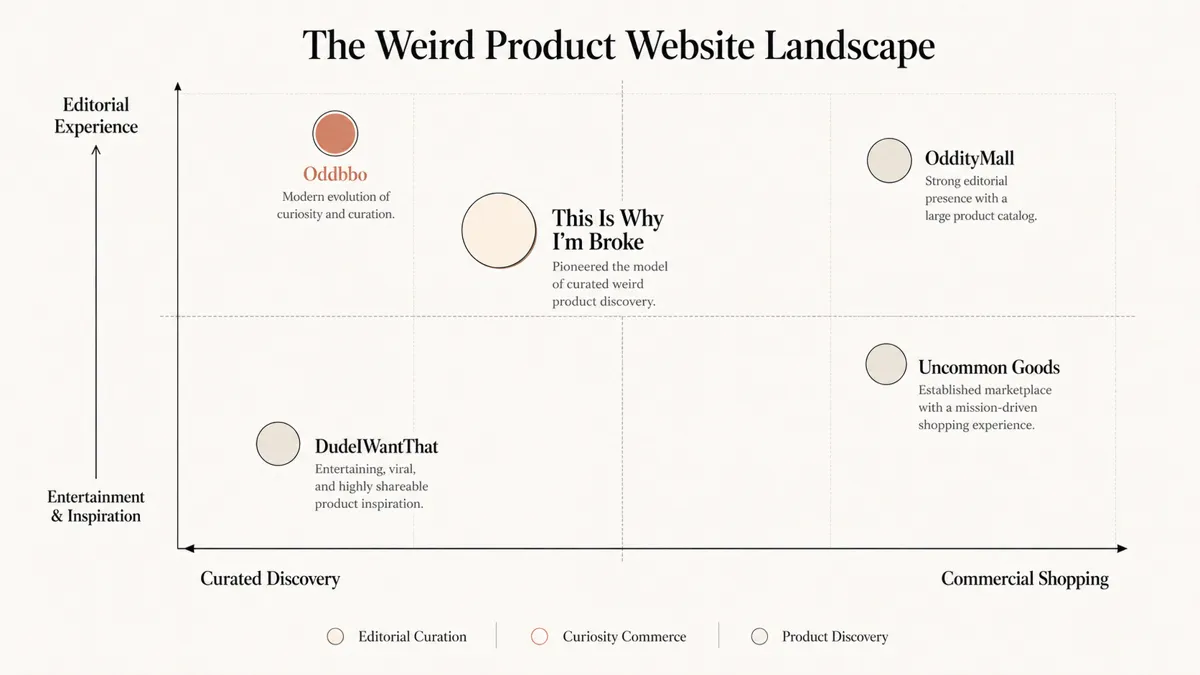
AI has made product discovery easier than ever. A user can now ask a chatbot for “the best unusual gifts under $50” and receive an instant list of recommendations. But AI struggles with something that made This Is Why I’m Broke valuable: personal taste. Some of the most successful unusual products are not valuable because they solve practical problems, but because they create emotional connections. Objects that trigger memories, nostalgia or personal associations demonstrate why people sometimes buy experiences rather than necessities. We explored this idea further in Objects That Smell Like Memories (But You Can Buy Them).
The future of curiosity-driven commerce will likely belong to publishers who combine technology with human judgement. The winning websites will not simply collect products; they will develop a point of view. They will know what their audience finds surprising, entertaining or worth sharing.
In that sense, building the next This Is Why I’m Broke is not about recreating an old affiliate website. It is about understanding the principle behind its success.
The opportunity today is not to recreate the catalogue, but to recreate the relationship between curiosity and trust. The most successful unusual products are often not remembered because they are strange, but because they eventually become part of people’s stories, spaces and daily lives. This is why some objects that initially appear unnecessary can become surprisingly meaningful over time.
The opportunity was always:
Become the trusted guide for discovering things people did not know they were looking for.
The Real Legacy of This Is Why I’m Broke
The story of This Is Why I’m Broke is easy to misunderstand.
At first glance, it appears to be a story about affiliate marketing. A website collected unusual products, sent visitors to Amazon and earned commissions from resulting purchases. From that perspective, the business seems simple enough that anyone could replicate it.
But the thousands of websites that attempted to follow the same formula reveal why that explanation is incomplete.
The true achievement of This Is Why I’m Broke was not building a better product catalogue. It was creating a better reason for people to pay attention.
Before the website existed, unusual products were scattered across the internet. Interesting inventions appeared on different marketplaces, independent stores and random corners of the web, but discovering them required effort and luck. This Is Why I’m Broke transformed that scattered information into a destination. It became a place where curiosity had somewhere to go.
That was the company’s real innovation.
It understood that online behaviour is not always driven by necessity. People do not spend time on the internet only because they need answers or want to complete transactions. They also browse because they want inspiration, entertainment and moments of surprise. The website succeeded because it built an experience around that human instinct.
The financial results followed naturally.
The affiliate commissions, advertising revenue and traffic numbers were consequences of a deeper achievement: earning attention at scale. Once millions of people trusted the site to consistently show them interesting things, monetisation became possible. The business model worked because the audience existed first.
This lesson remains relevant even as the internet continues to change.
Search engines, social networks and artificial intelligence have transformed how people discover information and products. A recommendation can now be generated instantly, and an algorithm can predict what someone might want before they even search for it. Yet the value of human curation has not disappeared.
In a world where information is increasingly abundant, judgement becomes more valuable.
The next generation of successful curiosity-driven websites will probably not look exactly like This Is Why I’m Broke. They may rely less on static product pages and more on newsletters, communities, video content or AI-assisted discovery. Their platforms may change, but their purpose will remain similar: helping people discover things they would never have found on their own.
That is why This Is Why I’m Broke remains an important case study more than a decade after its launch. It proved that a small team could build a meaningful internet business without manufacturing products, owning inventory or competing directly with giant retailers.
Its greatest lesson is not that weird products can make money.
It is that curiosity itself can become a business.
The internet has always rewarded those who understand what people want to see, share and remember. This Is Why I’m Broke simply discovered one of the clearest examples of that principle: sometimes the most valuable thing you can offer is not an answer, but a discovery.