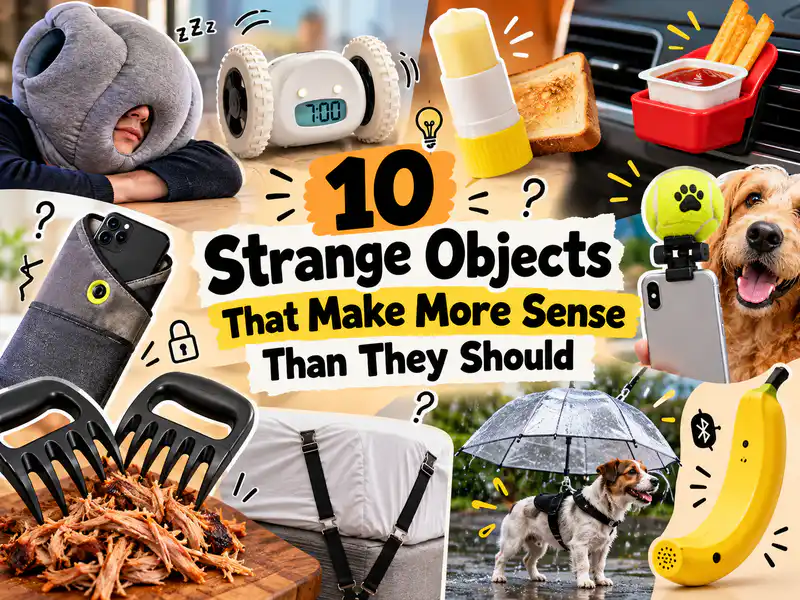
Some objects seem to arrive in the world already carrying a question.
Why does that pillow have a hole for your entire head? Why does an alarm clock need wheels? Why would anyone design a special holder for a packet of dipping sauce, or put suspenders on a bedsheet?
The easiest answer is that people like making weird things. Sometimes that’s true. There is an entire corner of consumer culture built around objects whose main purpose is to make someone laugh, look twice, or ask where on earth you found them. But some strange objects become more interesting when you stop looking at the object and start looking at the problem behind it.
An alarm clock that runs away sounds ridiculous until you remember how easy it is to hit snooze without fully waking up. A pouch that locks your phone away seems excessive until you notice how often your hand reaches for your phone before you’ve consciously decided to check it. Even a holder made specifically for fast-food dipping sauce begins to acquire a certain dignity the first time you try to balance an open container of ketchup somewhere inside a moving car.
The object hasn’t become less strange. It has simply acquired a reason.
That’s what connects the ten objects in this list. They aren’t here because they are the weirdest products ever made, and this isn’t an attempt to rank novelty gadgets by how absurd they look. Some have serious design thinking behind them. Some began with embarrassingly small annoyances. A few became businesses after their creators discovered that thousands of other people had apparently been annoyed by exactly the same thing.
And a couple probably exist because someone had a funny idea and was stubborn enough to manufacture it.
What they share is that small shift in perception that happens after the initial confusion:
That’s ridiculous. But actually… I can see why someone made it.
Once you start looking for that moment, weird products become much more interesting.
1. A Pillow You Wear Over Your Head
Ostrichpillow Original
There is no particularly dignified way to wear the original Ostrichpillow.
Pull it over your head and most of your face disappears inside a large padded cocoon. There is an opening around the nose and mouth, smaller openings for your hands, and enough volume around the rest of your head that, from across an airport lounge, you might reasonably wonder whether the person wearing it has fallen asleep or is participating in some obscure performance-art project.
It is exactly the sort of object that made the early internet very good at stopping people mid-scroll.
But the Ostrichpillow did not begin with the question, How can we make a pillow look stranger?
It came out of a much more ordinary problem: people are tired in places where sleeping is awkward.
Studio Banana founders Key Kawamura and Ali Ganjavian created the Ostrichpillow Original in 2012 after years of observing human behavior and thinking about sleep deprivation in modern working life. The studio had been experimenting with rapid design cycles, developing and testing new ideas in short bursts. When the first Ostrichpillow prototype was photographed and placed on the studio’s website, the reaction was immediate. According to Studio Banana, more than 250 emails arrived within hours from people asking where they could buy one.
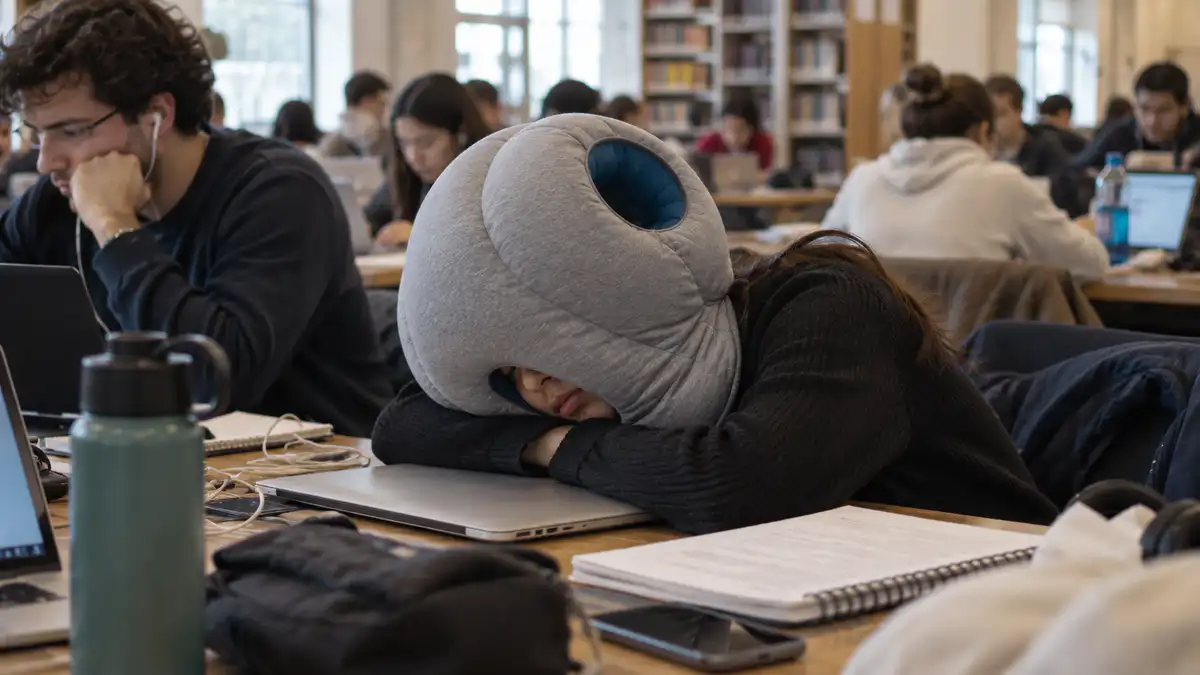
That response makes more sense when you stop thinking of it as an oversized pillow.
A normal pillow assumes a whole environment around it. There is probably a bed beneath you, a quiet room around you, somewhere to put your arms, and at least some expectation that you are supposed to be sleeping.
None of those assumptions work particularly well at an office desk, in an airport, on a train, or during twenty spare minutes between things you have to do.
Ostrichpillow approached the problem from the other direction. Instead of trying to bring a bed into those places, it tried to create a small piece of the experience of having somewhere private to rest. Studio Banana eventually described the idea in terms of creating “personal dreaming spaces,” and the Original became the first product in what the studio saw as a new category built around power napping.
That explains much of its peculiar shape.
The padded enclosure is not merely there to make the product memorable. It separates the head from some of the light and activity around it. The openings allow different resting positions, including putting your head and hands down on a desk. What initially looks like an unnecessarily elaborate pillow begins to resemble something closer to a tiny portable room—one that happens to stop around your shoulders.
There is still something undeniably funny about it. That matters too.
One reason unusual objects attract us is that they interrupt the visual grammar of everyday life. We already know what a pillow is supposed to look like, so an object that is clearly pillow-like but refuses to behave visually like a normal pillow demands another look. That tension between familiarity and unfamiliarity is part of what makes weird objects so difficult to ignore.
In Ostrichpillow’s case, though, the strange appearance isn’t something pasted onto an ordinary product after the fact. It comes directly from taking the problem further than a conventional pillow would.
If you genuinely want someone to be able to withdraw from a noisy environment for a short nap, the resulting object may simply have to look a little ridiculous.
Studio Banana later used crowdfunding as part of the development of the wider Ostrichpillow family, treating platforms such as Kickstarter not only as a source of funding but as a way to test whether people actually wanted these unconventional products. The Original eventually grew from a design experiment into the foundation of a standalone napping brand.
That journey—from strange prototype to recognizable product—is part of what makes the Ostrichpillow such a useful place to begin.
Sometimes an object looks weird because its designer has misunderstood the problem.
Sometimes it looks weird because the designer has taken the problem unusually seriously.
Oddbbo Pick
The original Ostrichpillow is still available today, and it remains much stranger on a human head than it does sitting by itself in a product photo.
See the Original Ostrichpillow →
2. An Alarm Clock That Runs Away From You
Most alarm clocks are surprisingly trusting objects.
They sit beside the bed, make a noise at the agreed time, and assume that the person who set the alarm the night before will behave like the same rational adult in the morning.
This arrangement has one obvious weakness.
The person who wanted to wake up at 7:00 p.m. is not necessarily the person making decisions at 7:00 a.m.
Gauri Nanda understood that problem particularly well. While studying at MIT’s Media Lab, she created Clocky as part of an industrial design class in 2004. The assignment was to make a practical product, and Nanda ended up attacking one of the smallest but most persistent battles of everyday life: the snooze button.
Her solution was not to make the alarm louder.
She gave it wheels.
The early Clocky was a fuzzy, almost pet-like digital clock designed to roll off the bedside table after its owner pressed snooze. It would move away and find somewhere else to stop. When the alarm sounded again, reaching toward the nightstand was no longer enough. The sleeper had to get out of bed, locate the clock and deal with it properly. MIT’s later account of the design notes that its route could vary, preventing the owner from simply learning where it would end up each morning.
There was even a surprisingly literal inspiration behind its personality.
Nanda had watched a litter of kittens wake her by nibbling at her toes in the morning. She wanted Clocky to have some of that same quality—not a cold piece of electronics issuing an instruction, but an irritating little creature that interfered with your attempt to remain asleep. She described the idea to MIT as wanting something like a troublesome pet that you nevertheless liked having around.
The original prototype looked the part. Covered in shaggy material and balanced between two wheels, it appeared less like a polished consumer electronic product than something that might scurry under the bed if you approached it too quickly.
Nanda had not initially planned to turn the class project into a business.
Then the internet found it.
After Clocky appeared among student work online, blogs began linking to the project. Requests arrived from people wanting to buy one, test one, distribute one or invest in the idea. MIT researcher Michael Bove, Nanda’s adviser at the time, said he could not remember another project attracting attention so rapidly. Nanda eventually patented the mobile wake-up concept, founded Nanda Home and worked with engineers to turn the fuzzy prototype into something that could survive being dropped from a bedside table every morning.
The commercial Clocky became cleaner and more toy-like, but the underlying idea remained wonderfully stubborn:
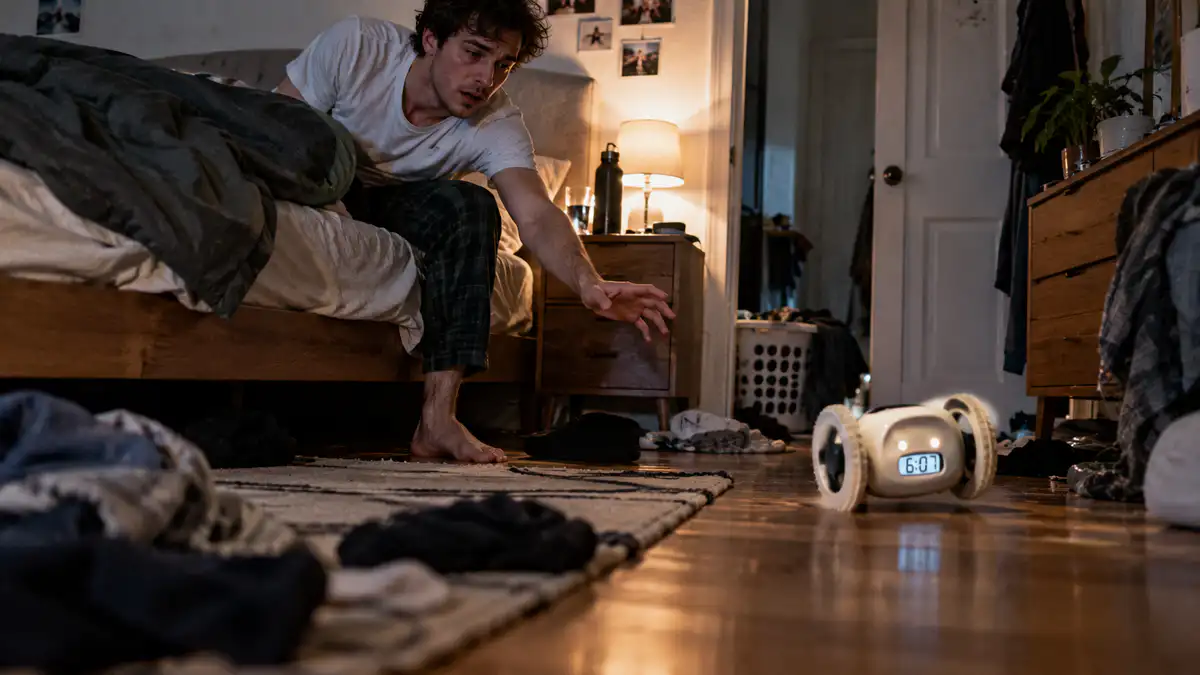
If you won’t get out of bed for your alarm clock, your alarm clock will make you come to it.
What makes Clocky interesting is that it violates one of the most common assumptions in product design.
We usually expect a well-designed product to remove friction.
A remote control saves us from walking across the room. One-click checkout saves us from filling out forms. Face recognition saves us from typing a password. Decades of consumer technology have trained us to see fewer steps as a sign of progress.
Clocky deliberately adds a step.
Actually, several steps—probably taken barefoot and in a bad mood.
The inconvenience is not an unfortunate side effect of the design. The inconvenience is the mechanism. Clocky recognizes that the problem isn’t simply waking a sleeping person. Ordinary alarm clocks already do that. The harder problem is preventing a half-awake person from making it effortless to continue sleeping.
That distinction turns a silly-looking alarm clock into a small piece of behavioral design.
It also hints at something we’ll see again later in this list. Sometimes the easiest action available to us is exactly the action we’re trying not to take. In those situations, a useful object may need to become less convenient rather than more convenient.
That idea sounds almost backward in a world built around frictionless technology, but it appears in more places than you might expect. It is one reason some deliberately awkward products can feel strangely satisfying—and part of the broader psychology behind why we are drawn to weird things in the first place.
Clocky’s story also demonstrates something else that matters here. It wasn’t designed as a novelty product and then given a justification afterward. The strange behavior came first because the behavior was the solution.
The wheels are the joke.
The wheels are also the point.
Oddbbo Pick
The original Clocky survived its strange journey from MIT class project to commercial product and is still sold as the alarm clock that runs away when you snooze it.
The first two objects on this list solve very different problems. Ostrichpillow tries to make an uncomfortable environment easier to escape from. Clocky deliberately makes a comfortable bed harder to remain in.
The next object is much simpler.
It doesn’t run away, hide your head, or try to change your behavior.
It just asks a question that becomes difficult to unsee once someone has asked it:
If butter is something we spread, why are we still spreading it with a knife?
3. Butter, Reimagined as a Glue Stick
Butter Stick / Butter Dispenser
A butter stick looks wrong for about three seconds.
The tube resembles something that belongs in a pencil case. Twist the bottom and a solid cylinder rises from the top. Then, instead of dragging a knife across cold butter and trying to spread the resulting lump without destroying your toast, you simply rub the stick across the surface.
It looks like glue.
Unfortunately, it also makes immediate sense.
The idea is older than the current wave of novelty kitchen gadgets. Patents for handheld butter dispensers go back decades, including designs intended to hold a standard stick of butter and apply it directly to corn, toast, meat and other foods. Different versions have appeared since then, which makes it difficult—and not especially useful—to crown one modern product as the original Butter Stick.
The recurring idea is more interesting.
A glue stick already solved a mechanical problem that butter happens to share: how to expose a controlled amount of a soft solid and spread it across a surface without holding the material itself.
Move that interaction from the stationery drawer to the refrigerator and suddenly the absurdity becomes mostly visual.
There are still trade-offs. A butter dispenser takes up space, needs cleaning, and does a job a perfectly ordinary knife can already perform. Nobody needs to redesign breakfast around one.
But necessity is a very high bar for household objects. Sometimes a product survives simply because one small action feels nicer when performed differently.
Oddbbo Pick
Butter-stick dispensers now come in several forms, from simple holders to twist-up designs that lean fully into the glue-stick resemblance.
And if a dedicated butter applicator feels like an excessive response to a minor inconvenience, the next object makes it look almost restrained.
4. A Cup Holder for Your Ketchup
Saucemoto Dip Clip
Cars have spent decades accumulating places to put things.
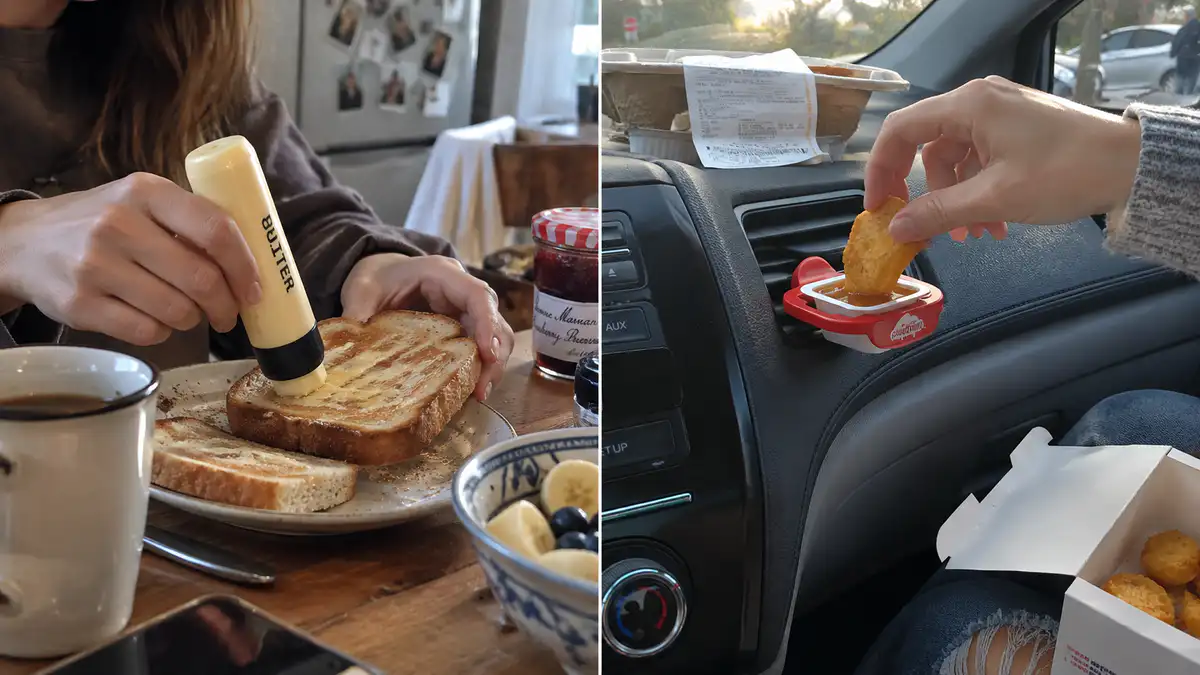
There are cup holders for coffee, slots for phones, compartments for sunglasses, pockets in the doors and trays hidden under armrests. Yet anyone who has tried eating fries or chicken nuggets in a car eventually encounters an oddly neglected piece of automotive infrastructure:
There is nowhere sensible to put the sauce.
You can balance it on the center console. Hold it in one hand while eating with the other. Wedge it into the food container and hope it stays upright. Or accept that ketchup on your jeans is now part of the journey.
Saucemoto exists because three people decided this inconvenience had gone unaddressed for long enough.
Michael Koury, Tony Lahood and William Moujaes, the team behind Milkmen Design, developed a small holder that clips onto a car’s air vent and supports the rectangular and round dipping-sauce containers used by many fast-food restaurants. The idea eventually reached Kickstarter in 2017 and later appeared on Shark Tank, turning a problem most people would barely think to complain about into an actual product business.
That is part of its charm.
Saucemoto does not pretend to solve anything important. It simply notices that millions of cars are carefully designed around the driver’s drink, while the ketchup is left to fend for itself.
The product is almost comically specialized, but specialization is what makes it work. A generic tray would take up more room. A cup holder is too large. The vent is already positioned within reach. Once those constraints are accepted, the little clip stops looking like an invention nobody needed and starts looking like a missing piece someone happened to notice.
Products like this also help explain why some of the world’s strangest products keep selling. The problem does not need to be universal, serious or expensive. It only needs to be recognizable enough that someone sees the solution and immediately remembers the last time the problem happened to them.
Saucemoto’s entire pitch can happen in that instant.
You see it.
You remember balancing sauce in your car.
And suddenly the ridiculous little plastic clip has a job.
Oddbbo Pick
The original Saucemoto Dip Clip is still sold today, alongside plenty of imitators inspired by the same very specific problem.
See the Saucemoto Dip Clip →
French Fry Holder
The next product began with an equally ordinary frustration, except the uncooperative party wasn’t a packet of sauce.
It was a dog.
5. The Tennis Ball That Makes Dogs Look at the Camera
Dogs are excellent photographic subjects right up until you want them to look at the camera.
Call their name and they look past you. Move the phone and they follow your hand. Finally get the composition right and they become fascinated by something happening six feet to the left.
Mechanical engineer Jason Hernandez ran into exactly that problem while trying to take photos with his dogs. A tennis ball worked wonderfully at getting their attention, but holding a phone and a ball at the same time created another problem.
The solution was almost embarrassingly literal:
Attach the ball to the phone.
That idea became Pooch Selfie, a small smartphone attachment designed to hold a tennis ball directly above the camera. Hernandez developed the concept into a product, took it to Kickstarter in 2015 and later brought it to Shark Tank.
The product looks like a joke until you think about who it is actually designed for.

A person understands what a camera is. A dog doesn’t care. Telling a dog to “look here” asks the animal to participate in a human activity it has no reason to understand.
A tennis ball changes the conversation.
The dog does not need to understand photography. It only needs to understand the object already sitting directly above the lens.
That is what makes Pooch Selfie more interesting than another pet accessory with a funny name. It doesn’t try to train the user into behaving differently. It changes the interface to fit the user’s existing behavior.
Admittedly, calling the dog the “user” may be stretching the language of product design.
But the dog is definitely the one deciding whether the photo works.
Oddbbo Pick
The original idea is wonderfully simple: put the thing your dog wants to look at exactly where you want your dog to look.
So far, most of these products manipulate the physical world to make an action easier.
The next one deliberately makes an action harder.
And unlike chasing an alarm clock across the bedroom, the behavior it is trying to interrupt follows many of us everywhere.
6. A Locked Pouch for the Device We Can’t Stop Checking
Yondr and the Logic of the Phone Jail
The smartphone may be the most successful convenience machine ever placed in a pocket.
Nearly everything about it has been optimized for access. It wakes when we lift it. It recognizes our face. Notifications appear before we ask for them. A few taps can summon food, entertainment, transportation, work, conversation and an effectively endless supply of things to look at.
Then companies began selling products whose purpose was to make the phone harder to use.
That sounds like technological regression until you consider the problem from the other side.
Graham Dugoni founded Yondr around the idea of creating phone-free spaces. Rather than asking people to switch off their phones and trust themselves not to reach for them again, Yondr places the device inside a pouch that remains with the owner but stays physically locked during the event or within the designated space.
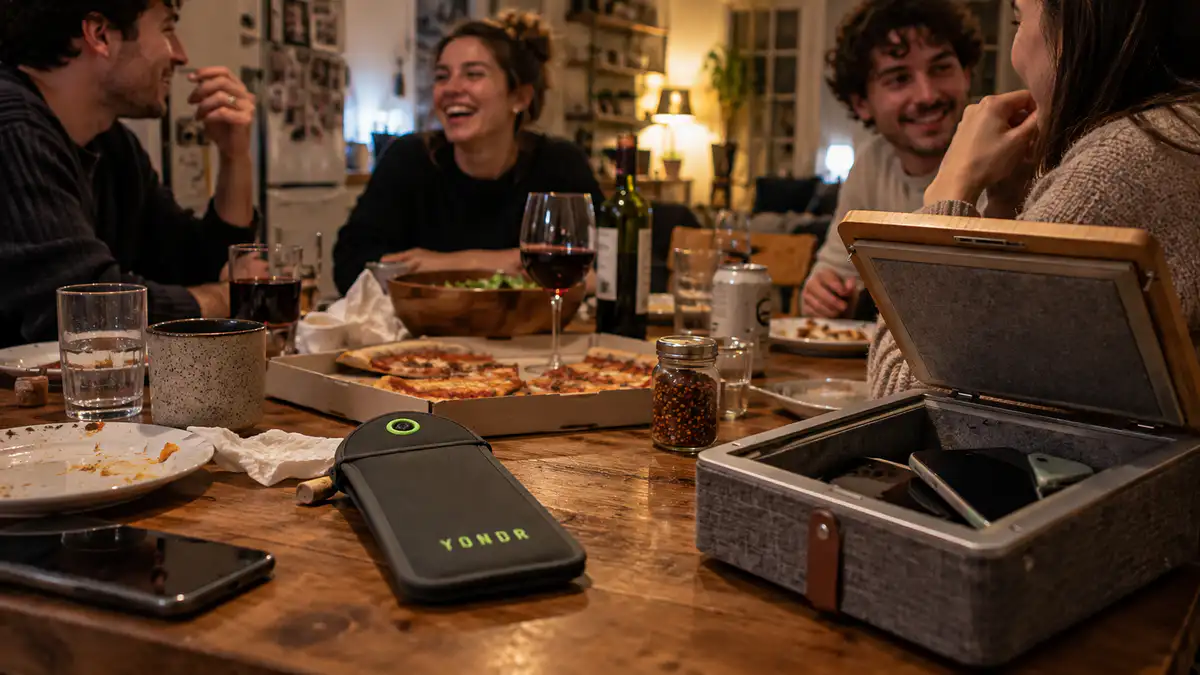
The idea grew from Dugoni’s interest in what phones were doing to shared experiences, particularly live events where a room full of people could be physically present while their attention drifted elsewhere. Yondr eventually moved far beyond concerts, appearing in schools, performances and other environments where organizers wanted the phone present but inaccessible.
It is a strange reversal.
For years, the design problem was:
How quickly can we get to our phones?
Yondr asks:
How can we stop ourselves from getting to them?
The pouch itself is not especially weird-looking. The weirdness lies in the fact that it needs to exist at all.
It also brings us back to Clocky.
Clocky doesn’t persuade a sleepy person to make a better decision. It changes the physical situation so the easiest bad decision—pressing snooze without getting up—is no longer quite so easy.
Yondr follows similar logic. A silent mode is a request. A notification setting is a preference. A locked pouch changes the environment.
In both cases, friction is being used deliberately.
That feels counterintuitive because so much modern product design treats friction as an enemy. Faster checkout, instant login, one-tap ordering and autoplay all reduce the gap between impulse and action. Usually we celebrate that.
But convenience can work too well.
Once an action becomes nearly effortless, sometimes the useful product is the one that puts a small obstacle back in the way.
That does not mean everyone needs to lock away a phone, or that a pouch magically solves our relationship with technology. It does make Yondr part of an interesting category of objects: products designed to protect us from conveniences we previously worked very hard to create.
The same idea has since appeared in consumer products, including timed lock boxes and literal “phone jails” intended for desks, dinner tables and bedrooms.
They look almost absurd beside a device capable of doing so much.
Perhaps that’s the point.
Oddbbo Pick
For home use, the same physical-friction idea now appears in timed phone lock boxes and simpler phone-jail designs.
After all that technology, the next solution is refreshingly primitive.
No app.
No timer.
No lock.
Just two enormous plastic claws.
7. Why Use Forks When You Could Have Claws?
Bear Paws Meat Shredder Claws
There is a perfectly normal way to shred cooked pork with two forks.
There is also a way that makes you look temporarily equipped to fight a bear.
Bear Paws took the second route.
The original product dates back to the 1990s and was created around a straightforward barbecue problem: ordinary dinner forks are not particularly good at controlling and pulling apart large pieces of cooked meat. They’re small, the grip is indirect, and the process can become slow and awkward.
Bear Paws enlarge the basic idea until the utensil starts resembling an extension of the hand. Each grip carries several thick pointed claws, allowing both hands to grab, hold, lift and shred at the same time.
Somewhere between kitchen utensil and Wolverine cosplay, the idea becomes genuinely practical.
A lot of tools are really extensions of the body disguised as objects. Tongs extend our grip. Knives give the hand a cutting edge. A ladle turns the palm into a deeper scoop.
Bear Paws barely bother with the disguise.
They simply give you bigger claws.
That literalness is why the product looks funny and why the product works.
Oddbbo Pick
The original Bear Paws still exist, although the basic claw design has since spread across countless barbecue-tool sets.
The same kind of literal thinking becomes even stranger when it leaves the kitchen.
Because apparently bedsheets need accessories too.
8. Suspenders, but for Your Bedsheets
Sheet Suspenders
There is a particular kind of household annoyance that never becomes important enough to fix properly.
A fitted sheet slips off one corner of the mattress.
You pull it back.
A few nights later, it happens again.
Repeat for years.
Sheet suspenders are what happens when someone eventually decides this has gone on long enough.
Different versions have existed for decades, using elastic straps and clips beneath the mattress to keep the sheet stretched into position. Some attach across individual corners; others cross beneath the mattress in arrangements that look remarkably similar to the suspenders used to hold up clothing.
Which is appropriate, because the mechanical problem is basically the same.
Flexible material wants to move.
Elastic tension tells it not to.
Once that similarity is noticed, the idea becomes almost painfully obvious. Nobody needed to invent a new fastening principle. They only needed to take an existing one and put it somewhere we weren’t accustomed to seeing it.
There is a peculiar category of invention that begins not with ambition, but with being annoyed one too many times.
Saucemoto belongs there.
So do sheet suspenders.
Neither is likely to appear in a museum of civilization-changing inventions, but both make immediate sense to the person who has experienced exactly the problem they solve.
Oddbbo Pick
Modern sheet fasteners range from simple corner clips to full under-mattress suspender systems.
And then there are products that look backward only because we’re looking at them from the wrong point of view.
9. An Umbrella Designed From a Dog’s Point of View
Dog Umbrella
A dog umbrella appears to have been assembled incorrectly.
The handle is on one end, the canopy seems to face the wrong way, and the dog walks underneath while the human follows behind holding what looks like an umbrella turned inside out.
But a normal umbrella is designed around a human body.
The person beneath the canopy is also the person holding the handle.
A dog cannot do that.
Once the human hand moves behind the animal, the structure has to change with it. The handle stays with the person; the canopy moves over the dog. Add a leash connection and the apparently backward umbrella starts to reveal its logic.
The idea is older than the endless versions now sold online. Patent records show that people have experimented with umbrella-like protection for dogs for decades, although earlier designs varied considerably in purpose and construction. Later versions moved closer to the familiar leash-and-canopy arrangement sold today.
There is no need to invent a heroic origin story for it.
The design itself is enough.
Dog umbrellas look strange because umbrellas are so familiar that we rarely notice how specifically they are shaped around the human using them. Change the body under the canopy and the familiar object has to become unfamiliar too.
Sometimes strange design is ordinary design viewed from a different body.
Oddbbo Pick
Modern dog umbrellas are now available in several sizes and configurations, particularly for smaller dogs that don’t enjoy getting soaked on short walks.
We’ve now reached products created for sleep, waking up, breakfast, fast food, dogs, phones, barbecue and bedsheets.
The final object solves almost nothing.
That may be why it belongs here.
10. A Banana That Finally Became a Phone
Banana Phone
People were pretending bananas were telephones long before Bluetooth existed.
The gesture barely requires imagination. Hold a banana near your face and the curve naturally brings one end toward your ear and the other toward your mouth. Children understand the joke without instructions.
Eventually, someone made the joke functional.
The modern Banana Phone was developed by Brian Brunsing, Max Brown and Charlie Katrycz, turning the familiar banana-as-telephone gag into a Bluetooth handset that connects to a smartphone. The product went through crowdfunding before becoming a commercial device, and the company also tied the joke to donations supporting gorilla conservation.
There are more technologically impressive ways to take a call.
Nearly all of them look less like fruit.
Unlike Clocky, Banana Phone does not need to force a behavioral change. Unlike Saucemoto, it does not address a frustrating gap in existing infrastructure. Unlike Pooch Selfie, it doesn’t solve a communication problem between species.
Its logic is almost entirely visual.
A banana already has a curved body.
It already has two obvious ends.
It already sits comfortably in the hand.
And generations of people had already collectively agreed that it looked enough like a telephone to pretend.
The designers mostly had to take the joke seriously.
That distinction matters because “makes sense” does not always have to mean “more efficient.” Objects also live in social spaces. We show them to people. Give them as gifts. Leave them on desks. Use them to start conversations. Sometimes making an ordinary action slightly more ridiculous is the function.
The Banana Phone does not need to justify itself by saving time.
It makes answering a call more memorable.
For a strange object, that can be enough.
Oddbbo Pick
Yes, the Bluetooth Banana Phone is a real thing. And yes, you can actually take calls on it.
What These Objects Have in Common
Put these ten objects on the same table and they would look like the contents of a particularly confused lost-and-found box.
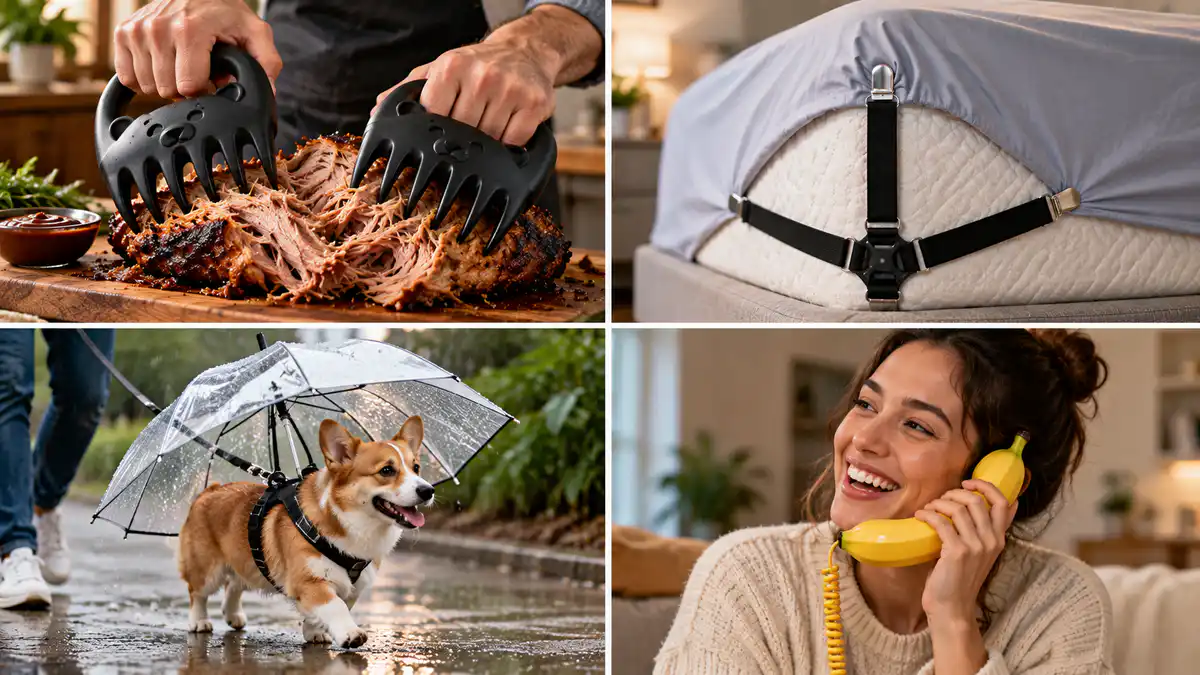
A giant pillow for your head. A wheeled alarm clock. A butter dispenser. A sauce holder. A tennis ball attached to a phone. A locking pouch. Plastic claws. Elastic straps. An inverted umbrella. A Bluetooth banana.
There is no obvious product category connecting them.
The connection is in the way their designers looked at ordinary behavior.
Clocky and Yondr introduce friction where convenience has become part of the problem. Ostrichpillow changes the environment around a familiar activity. Butter sticks and sheet suspenders borrow mechanisms from unrelated objects. Saucemoto takes a tiny inconvenience seriously enough to design around it. Pooch Selfie works with a dog’s existing behavior instead of asking the dog to understand ours. Bear Paws exaggerate the body. Dog umbrellas rearrange a familiar object around a different body. Banana Phone notices that the joke was already hiding in the shape.
None of these approaches begins with the instruction:
Make something weird.
The weirdness appears because the designer has stepped slightly outside the normal assumptions surrounding the object.
That distinction is useful when browsing unusual products online. There are endless objects that are strange because somebody changed the color, printed a joke on the side or attached an animal face to something that didn’t need one. Those can be fun, but the surprise often ends after the first look.
The objects that stay interesting usually give you something else to discover.
A reason.
A story.
A small design decision you didn’t notice until someone pointed it out.
That is also why some weird products survive long after the initial novelty should have disappeared. Once people actually use them, the strange object can slowly become an ordinary part of life—something we’ve seen happen with plenty of weird objects that quietly become familiar.
The first reaction may still be laughter.
The second reaction is more valuable:
Wait. That’s actually kind of clever.
Weird Is Sometimes Just Unfamiliar Logic
We started with a simple question:
Who thought this was a good idea?
It is usually meant as an insult.
But it becomes a much better question when we actually want to know the answer.
Sometimes the answer is a tired designer wondering how to nap at work. Sometimes it’s a graduate student who knows she will hit snooze in the morning. Sometimes it’s three people annoyed by dipping sauce in a car, an engineer trying to photograph his dogs, or someone who has pulled the same bedsheet back over the same mattress corner one too many times.
And sometimes somebody looks at a banana and thinks, That is basically already a phone.
The object seems strange because we usually encounter the solution before we encounter the problem.
Once the problem becomes visible, the object changes.
Not completely. Ostrichpillow still looks ridiculous on a human head. Clocky is still an alarm clock you may have to chase across the bedroom. Bear Paws still make dinner preparation look unnecessarily dramatic.
Understanding them doesn’t remove the weirdness.
It gives the weirdness context.
That’s the idea behind Odd Picks.
Oddbbo has always been interested in objects that interrupt ordinary browsing—the things that make you stop, look twice and wonder why they exist. Odd Picks goes one step further. Instead of stopping at that’s weird, we want to know whether there is something worth discovering underneath it: a clever idea, a peculiar history, an overlooked problem, or simply a joke good enough that someone turned it into a real object.
Because the best strange objects don’t stop being weird once you understand them.
They simply become weird for a reason.
More Odd Things Worth a Look
The internet has no shortage of objects that make normal things unnecessarily—or unexpectedly—interesting.