There is probably something in your kitchen drawer that hasn’t been touched in months. A slicer made for one particular vegetable. A strangely shaped spoon. Some plastic contraption that promised to simplify cooking, then quietly became one more thing to wash.
Kitchen gadgets have a peculiar talent for solving problems we didn’t know we had. Sometimes the solution is genuinely clever. Sometimes the problem was never especially serious. And occasionally, an invention is so ridiculous that we want it even after realizing a knife, fork, or ordinary bowl could accomplish much the same thing.
Consider a plastic woman who gets angry in the microwave. Or a vampire designed to crush garlic. Or a pencil sharpener that accepts carrots instead of pencils.
These are real kitchen products, and their appearances are only half the story.
Some strange kitchen gadgets rethink the mechanics of everyday tasks. Others make familiar chores more entertaining without necessarily making them easier. The interesting question isn’t simply whether they work, but whether their usefulness justifies giving them a permanent home in your kitchen.
We looked at nine unusually designed kitchen tools, focusing on the problems they claim to solve, how their designs work, and where their limitations become apparent.
Some make a convincing case for themselves. Others are much easier to appreciate than to justify.
Editor’s note: This is a research-based selection, not a hands-on test of all nine products. Our observations draw on manufacturers’ specifications, published product testing, and available user feedback. Where a design’s benefits haven’t been independently established, we’ve treated them as possibilities rather than proven improvements.
1. Angry Mama Microwave Cleaner — A Little Woman With a Serious Temper
The problem: Dried food splatters inside a microwave.
Open a neglected microwave and you may discover the remains of several meals. There’s sauce on the ceiling, something sticky near the door, and a mysterious stain at the back that appears to have survived multiple reheatings.
Now imagine putting a furious-looking plastic woman in the middle of it.
The Angry Mama Microwave Cleaner has folded arms, a scowling expression, and a removable head. Fill the container with water and vinegar according to the instructions, place it in the microwave, and heat it. Steam escapes through openings near the top of her head, making it look as though she’s literally boiling with rage.
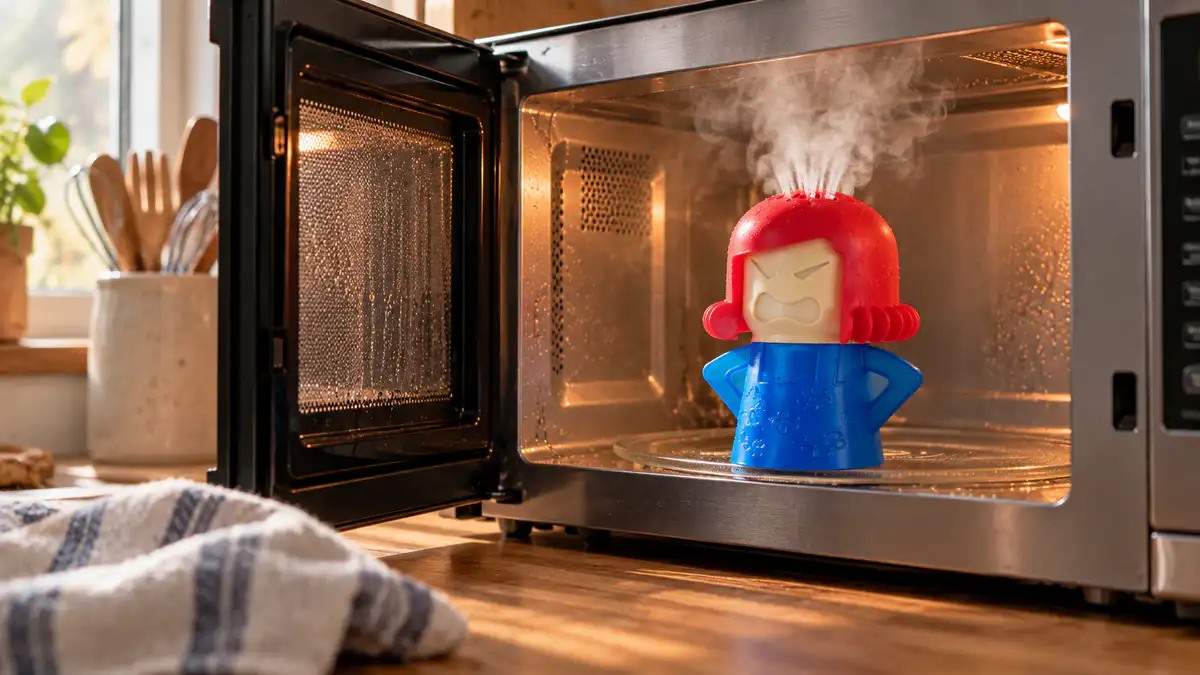
It’s a wonderful visual joke. But the cleaning principle is nothing new.
Steam helps soften dried food residue, making it easier to wipe away. You can accomplish something similar with a microwave-safe bowl of water, which raises an obvious question: what exactly are you paying for?
Independent experiences offer a useful reality check. In a 2019 review for The Kitchn, Lisa Freedman found the cleaner amusing but not compelling enough to buy for herself. A later test by Emma Kumagawa was more enthusiastic about how easily the steamed-on mess wiped away, while acknowledging that a bowl could perform the same basic job.
Those accounts aren’t necessarily contradictory. Both point to the same underlying mechanism; they differ mainly in how much they value the packaging and convenience.
Angry Mama doesn’t scrub anything by herself. You still need a cloth or sponge, and stubborn residue may require further cleaning.
What she adds is a bit of theater to an unpleasant chore.
For someone who enjoys playful household objects, that might be reason enough. For someone interested only in the most efficient cleaning method, the kitchen cupboard probably already contains a suitable alternative.
Just let the heated contents cool before handling the cleaner, and follow the instructions supplied with the specific product.
2. Dreamfarm Fluicer — The Lemon Squeezer That Folds Flat
The problem: Squeezing fresh citrus without unnecessary effort or bulky tools.
Most handheld citrus squeezers have a familiar arrangement: a cup for the fruit and two handles that press vertically together.
The Dreamfarm Fluicer looks as though somebody took that design apart and reassembled it sideways. When opened, its two arms form an unusual angular space for a halved lemon. Closing them squeezes the fruit from the sides rather than relying on the familiar top-down pressing action.
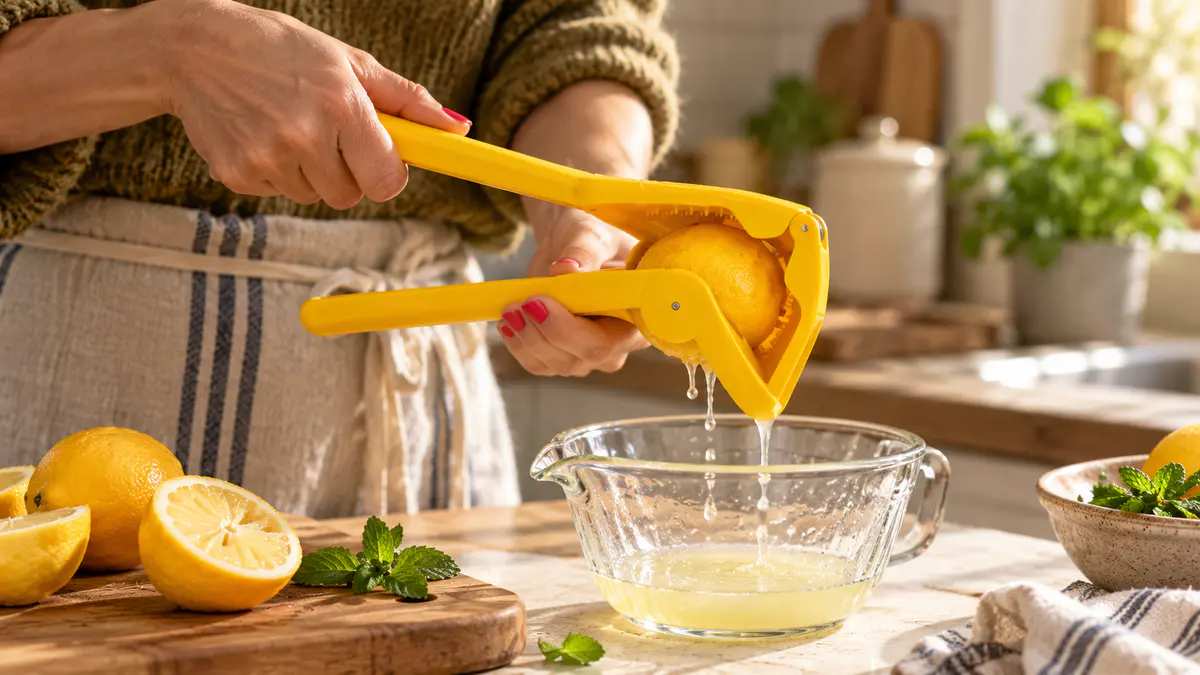
The shape is strange, but it has a mechanical purpose. Its design uses leverage to apply pressure around the fruit while channels help guide juice out and catch seeds.
Then the tool does something conventional citrus squeezers usually cannot: it folds almost completely flat. That matters if your kitchen drawers are already crowded. Unlike some novelty tools, the Fluicer also has independent testing behind it.
In a 2024 Bon Appétit comparison, Adam Campbell-Schmitt tested the Fluicer against a conventional citrus squeezer and a reamer using lemons of similar weight. All three extracted just over two fluid ounces per lemon. The Fluicer did not produce a meaningful juice-volume advantage in that test, but it completed the squeezing with less repeated effort and was easier to store.
That’s a much more interesting result than claiming it somehow extracts extra juice from the same lemon. Its real advantage appears to be the way it performs the task, not the amount of liquid it produces.
There are practical considerations. Dreamfarm offers different sizes for different citrus fruits, so a lemon-sized model isn’t necessarily the ideal choice for an orange. The tool also takes up room when opened for washing, even if it stores flat afterward.
Still, among these nine gadgets, the Fluicer makes one of the strongest arguments for unusual design serving an ordinary purpose.
If you frequently squeeze fresh lemons or limes, especially for drinks and cooking, it’s worth a closer look. If a few drops from a lemon wedge are all you normally need, the extra equipment may be unnecessary.
Explore the Fluicer on Amazon →
3. OTOTO Gracula Garlic Crusher — A Vampire With an Unusual Appetite
The problem: Crushing garlic without relying entirely on a knife.
Vampires are supposed to be terrified of garlic. Gracula apparently missed that part of the story.
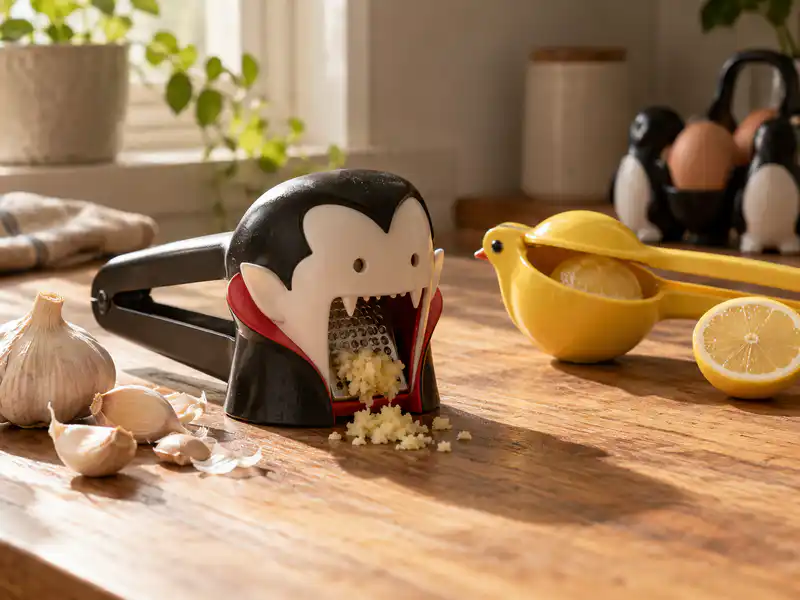
Created by OTOTO Design in collaboration with designer Lilach Eytan, this miniature vampire has a pale face, a black cape, and a surprisingly practical secret hidden beneath his head. Remove the top, put peeled garlic inside, and twist the two sections together. The textured internal surfaces crush the cloves as the vampire rotates.
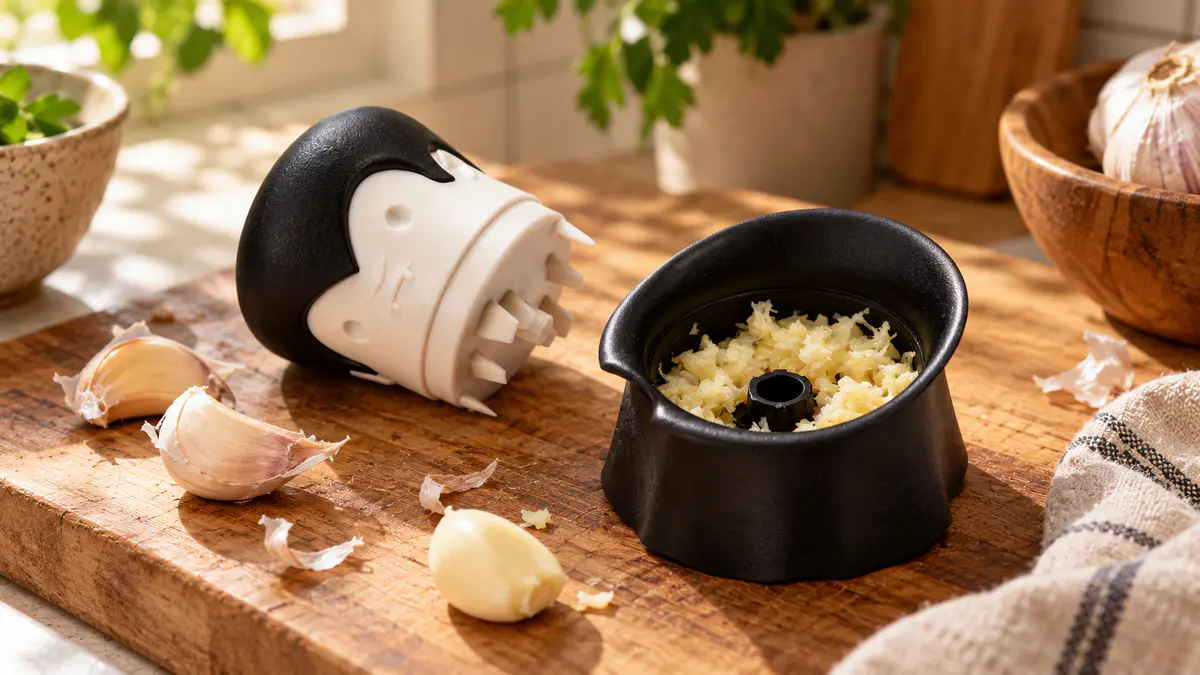
It’s a particularly satisfying design joke. The very ingredient that traditionally repels vampires has become this vampire’s occupation.
According to OTOTO’s product instructions, the same twisting mechanism can also handle small amounts of ingredients such as ginger, herbs, and nuts. But Gracula doesn’t eliminate every inconvenient part of garlic preparation.
You still have to peel the cloves. You have to empty the crushed garlic from the container. And the interior needs washing, preferably before garlic residue dries into its textured surfaces.
The manufacturer specifies hand washing for the product.
Whether it’s more efficient than a knife or conventional garlic press depends on how you cook. If you’re preparing a large quantity of garlic, a bigger tool may be faster. If you’re processing a few cloves, the difference may matter less than the pleasure of using something amusing.
And pleasure is a legitimate part of design, even when it doesn’t translate into measurable minutes saved. Gracula isn’t a revolution in food preparation. He’s a familiar crushing mechanism wearing a vampire costume.
For someone who enjoys unusual kitchen accessories, that combination is hard to dislike. For a cook who values speed above everything else, the cape won’t necessarily improve dinner.
4. NEGG Egg Peeler — Why Would Shaking an Egg Make It Easier to Peel?
The problem: Removing stubborn shells from hard-boiled eggs.
There are few kitchen tasks more unexpectedly frustrating than peeling a stubborn hard-boiled egg. You remove a little shell. Then another fragment. Then a piece of egg white comes off with it, leaving a crater where breakfast was supposed to be smooth.
The NEGG proposes a counterintuitive solution: shake the egg.
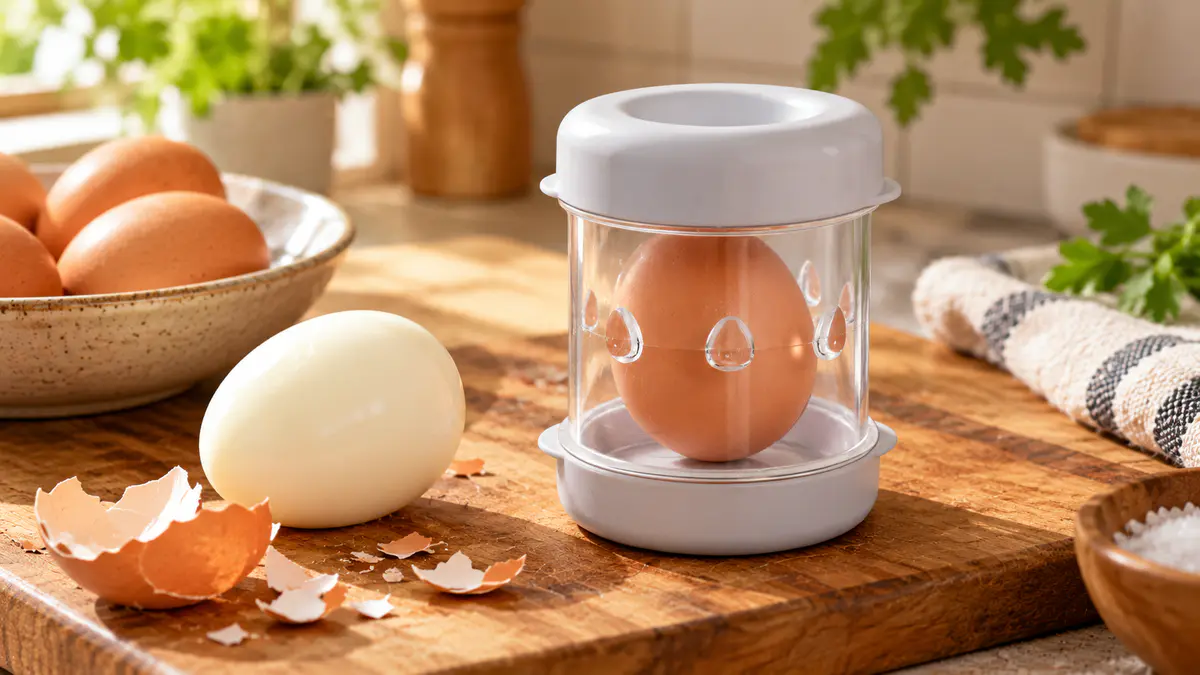
It’s a small cylindrical container with a lid, designed specifically for loosening the shells of hard-boiled eggs. According to the manufacturer’s instructions, you add about a quarter cup of water, insert a cooled hard-boiled egg, close the cap, and shake it a few times.
The movement cracks the shell and helps separate it from the egg. You can then remove the shell, occasionally with a little additional rolling or handling.
The strange part isn’t the appearance. NEGG looks like an ordinary little plastic container. It’s the idea of deliberately shaking something we’ve spent our lives learning to handle carefully. But don’t mistake a clever principle for a guaranteed result.
The manufacturer acknowledges that some eggs resist peeling and that shaking too forcefully can damage them. Cooking and cooling conditions also matter. NEGG recommends an ice bath as part of its egg-preparation method.
This makes the product especially interesting for people who prepare hard-boiled eggs regularly.
A container devoted entirely to egg peeling might seem excessive if you eat one boiled egg every few weeks. If you’re making deviled eggs for a gathering or preparing several days’ worth of snacks, the repeated inconvenience becomes more noticeable.
That’s the underlying logic of many specialized kitchen tools: a tiny irritation can become worth solving when it happens often enough. NEGG isn’t for everybody. But it isn’t quite as absurd as shaking breakfast initially sounds.
See the NEGG Egg Peeler on Amazon →
5. Monkey Business Karoto — Someone Made a Pencil Sharpener for Carrots
The problem: Creating vegetable curls and decorative garnishes.
You probably haven’t looked at a pencil sharpener and wondered whether it could help prepare lunch. Designer Avichai Tadmor apparently saw an opportunity.
The Monkey Business Karoto takes the familiar mechanism of a pencil sharpener and enlarges it to accept certain vegetables. Insert a carrot, rotate it, and watch ribbons of vegetable curl away instead of pencil shavings. The resemblance is so immediate that the product barely needs explaining.
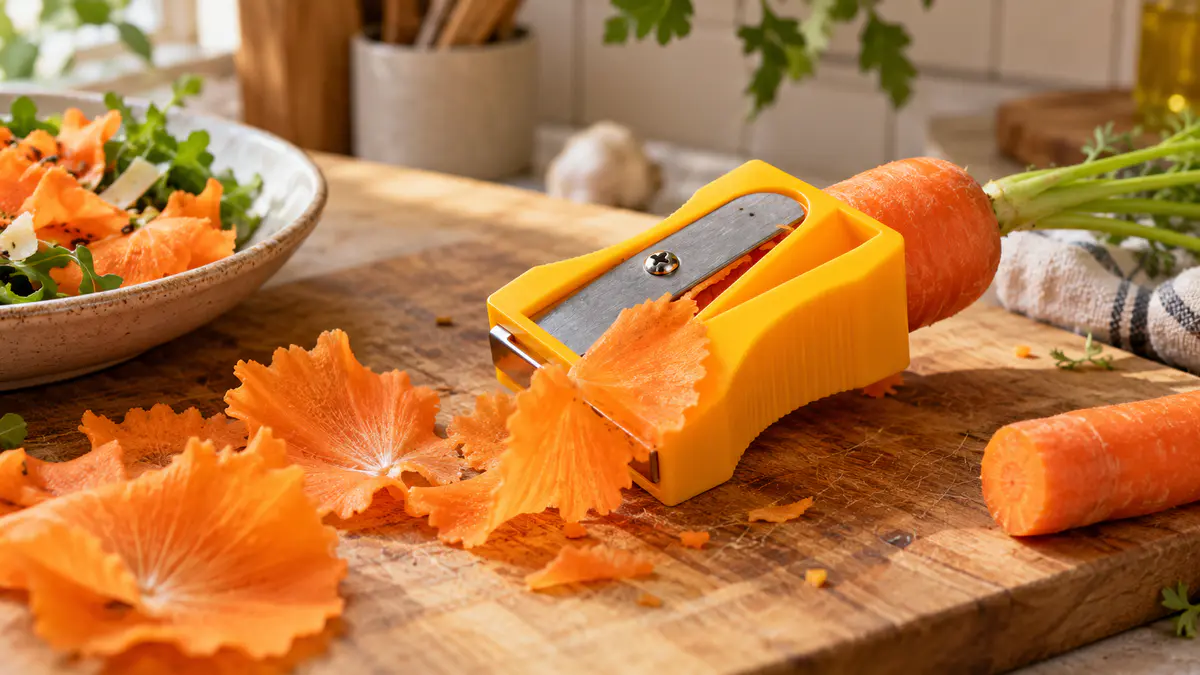
This is the kind of weird kitchen gadget that makes people stop scrolling. It’s not shaped like a vegetable, nor is it merely decorated with a funny face. It takes a mechanical idea from an entirely different activity and makes it relevant to cooking.
The original Karoto has separate blades for peeling and curling vegetables such as carrots and cucumbers. The brand also sells a Karoto Julienne version, so buyers should check which blade configuration they’re actually getting.
That distinction matters, because Karoto isn’t necessarily a replacement for a regular vegetable peeler.
Its most interesting work involves food presentation: curls for salads, playful vegetable garnishes, and the occasional lunch that looks as though it has been prepared with stationery.
It might be useful for someone who enjoys decorating food or encouraging a little creativity at mealtimes. It makes less sense as the main tool for preparing a mountain of vegetables. A knife is more versatile. A standard peeler is probably faster for ordinary peeling. But neither gives you the peculiar satisfaction of sharpening a carrot.
Karoto solves a modest problem, and it doesn’t need to pretend otherwise. Its charm lies in making a small creative task easier and more entertaining.
6. SURETIVIAN Chicken Shredder — A Plastic Bowl That Tears Meat Apart
The problem: Shredding large portions of cooked meat by hand.
Shredding cooked chicken isn’t difficult in principle. Take two forks, pull the meat apart, and repeat. The trouble begins when there is a lot of chicken.
A twist-style meat shredder offers a very different approach. The SURETIVIAN Chicken Shredder uses a bowl-like body and a rotating lid with internal teeth. Place suitable cooked meat inside, close the container, and twist the two sections against each other.
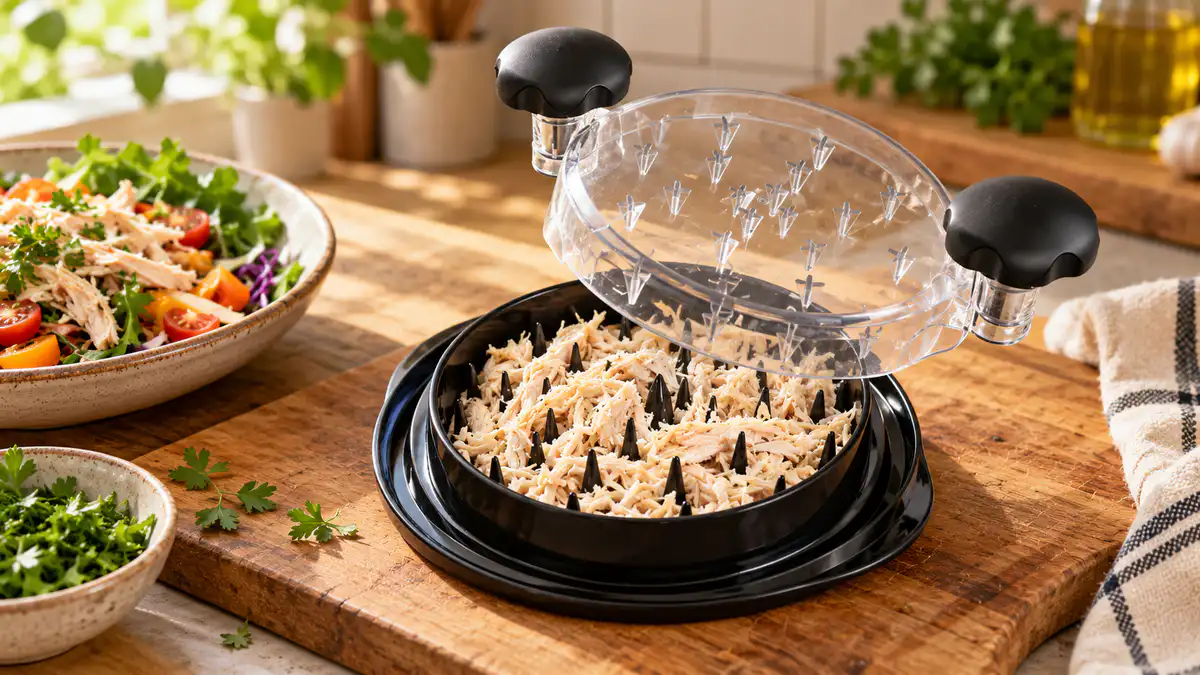
The internal ridges work through the meat as the pieces move around. It resembles a tiny industrial machine designed for something two forks have been doing perfectly well for generations. But this is one occasion when the scale of the job matters.
Preparing enough shredded chicken for several sandwiches, a week’s worth of lunches, or a large batch of tacos involves a lot more repetitive pulling than making a single serving. For larger quantities, a dedicated tool may reduce some of that work. It isn’t necessarily a perfect solution, though.
The amount of meat placed inside, how tender it is, and the number of rotations may affect the texture. Some users of twist-style shredders report uneven results or the need to reposition larger pieces.
Then there’s the cleanup. A container filled with raised internal teeth has more surfaces to wash than two forks. It’s also important to distinguish this specific branded model from the many similarly shaped products sold online. Material, construction, and cleaning instructions may vary. The trade-off is straightforward: potentially easier batch preparation in exchange for another specialized tool that needs storage and cleaning.
If shredded chicken or pulled pork is a regular part of your cooking, that exchange may make sense. If you only need a handful of meat for one sandwich, the two forks are probably already within reach.
View the Chicken Shredder on Amazon →
7. OTOTO Spaghetti Monster — The Pasta Strainer That Stares Back
The problem: Draining pasta and rinsing vegetables.
Some inventions look strange because they’ve changed how a task works. Others look strange because somebody gave an ordinary tool enormous eyes.
The OTOTO Spaghetti Monster belongs firmly to the second group.
It’s a yellow, monster-shaped colander with oversized eyes and playful, tentacle-like contours. Fill it with spaghetti and the whole scene becomes even more ridiculous, as though the creature has somehow grown a head full of noodles. But underneath the personality, the job is familiar.
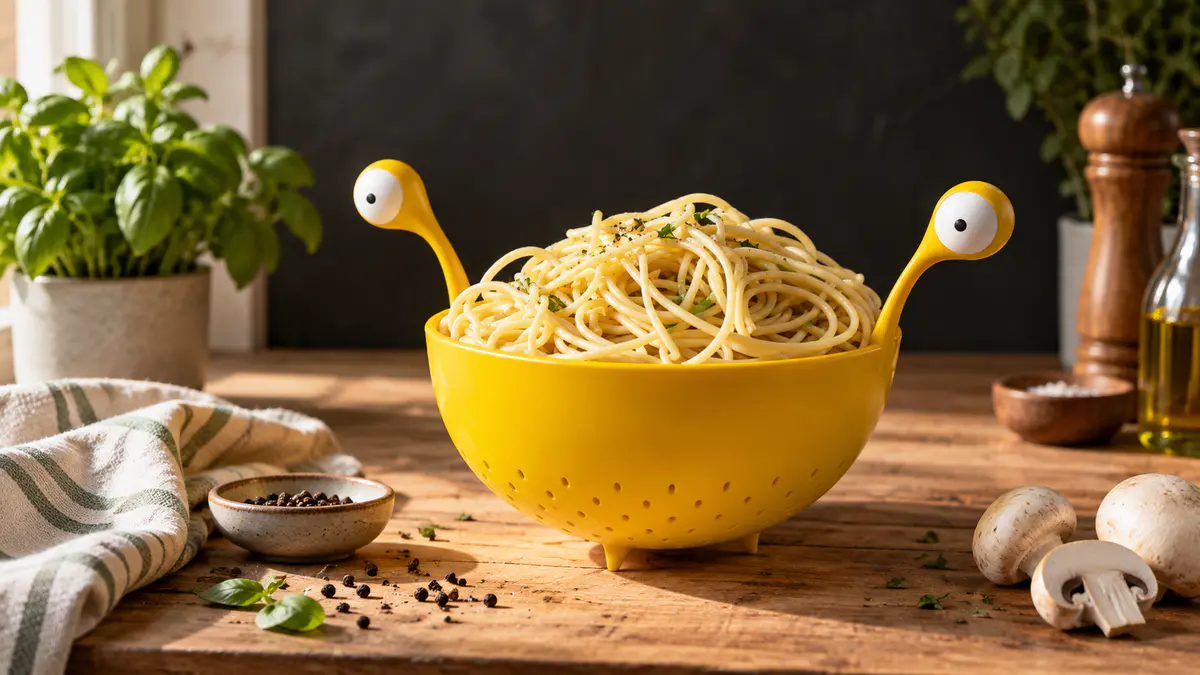
Water passes through the holes. Pasta stays inside. The structure allows the colander to be lifted and handled. That’s essentially what any colander does. The monster isn’t trying to reinvent gravity or filtration. It’s trying to make one of the kitchen’s least remarkable objects considerably more entertaining. There is something refreshing about that honesty.
Not every memorable product needs a complicated mechanical innovation. Sometimes designers simply notice that an everyday object could be more interesting to look at. The practical questions remain ordinary, though.
Does it fit comfortably in your sink? Is the capacity right for the amount of pasta you cook? How easy is it to clean and store? And is replacing a perfectly functional colander worth the additional visual entertainment? Those are better questions than assuming its unusual appearance makes it superior.
There is also a shopping detail worth checking: OTOTO has sold both the Spaghetti Monster colander and similarly named Pasta Monsters serving utensils. They are different products, despite sharing the monster theme.
If you already need a new colander, Spaghetti Monster offers a playful choice. If yours works perfectly, you’re mostly considering a personality upgrade.
Which, depending on your relationship with your kitchen, might still be tempting.
8. Joseph Joseph Chop2Pot — A Cutting Board That Knows When to Fold
The problem: Transferring chopped ingredients into a pot without scattering them everywhere.
There is a particular kind of minor kitchen disaster that almost everyone recognizes. You’ve finished chopping an onion. The pieces are neatly gathered on the cutting board. You lift the board toward the pan, tilt it slightly, and suddenly the onions are heading in several directions.
Joseph Joseph’s Chop2Pot addresses that moment with an elegantly simple trick.
While you’re chopping, it works like a relatively conventional cutting board. When you’re ready to transfer the ingredients, squeeze the handle and the sides fold upward, creating a channel that guides the food toward its destination.
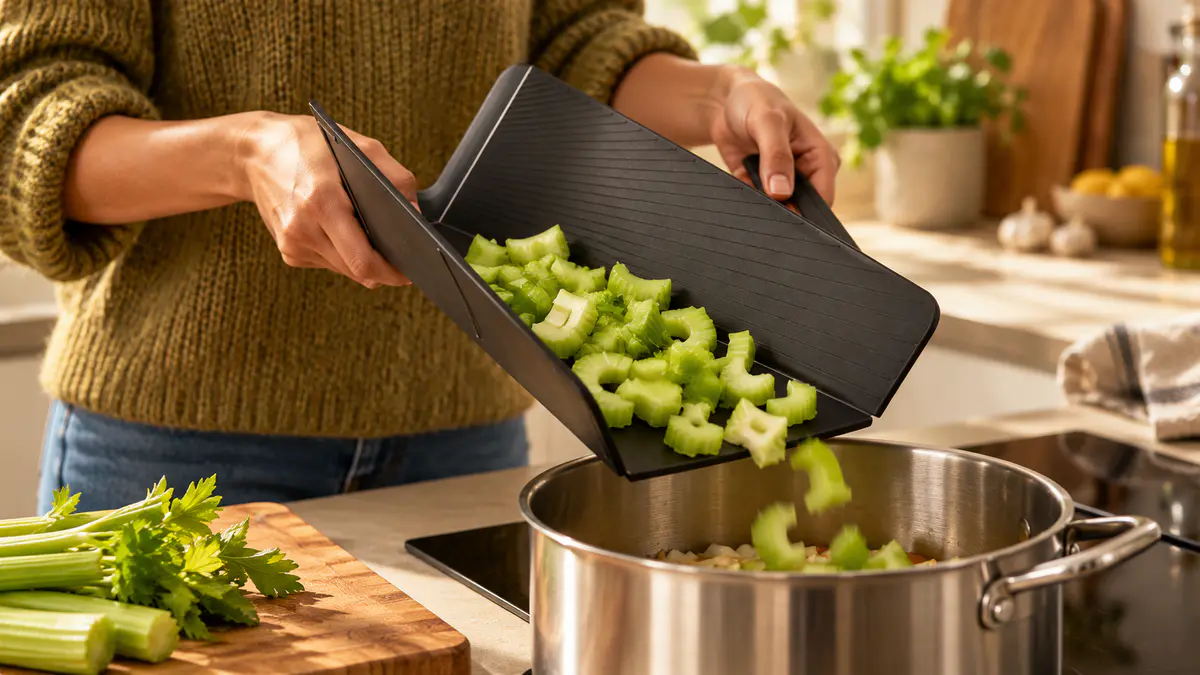
The cutting board briefly becomes a scoop. What’s interesting here is how little the product actually changes. It doesn’t introduce a new blade, motor, or cooking process. It modifies the shape of a tool you already use, making the transition between cutting and transferring easier to manage.
The Chop2Pot Plus is one of the clearest examples in this collection of practical design emerging from a small, familiar annoyance.
But flexible construction brings compromises. A cutting board needs to provide a stable working surface, and not every task benefits from a folding structure. Long-term durability of the folding areas matters, as does choosing a board large enough for the amount of food being prepared. Customer feedback is generally appreciative of the transfer feature, although individual experiences vary regarding size, surface preference, and durability.
None of that makes Chop2Pot a universally better cutting board. Someone who spends a lot of time preparing ingredients and moving them directly into pans may appreciate its folding design. Someone who needs a large, rigid board for heavier chopping may prefer something more traditional. The cleverness here is quiet.
Chop2Pot doesn’t try to make cooking more entertaining through an animal face or visual joke. It notices where an ordinary process becomes awkward and changes the tool just enough to help.
Of all the objects on this list, it’s one of the easiest to imagine using without thinking about how unusual it is.
Perhaps that’s the strongest compliment a practical design can receive.
9. Peleg Design Egguins — Six Penguins Taking a Boiling Bath
The problem: Handling multiple eggs together while cooking or storing them.
Imagine lifting a saucepan lid and finding six little penguins standing together in the water. Each one has an egg inside its belly. This is Egguins, a penguin-shaped egg holder from Peleg Design. It holds up to six eggs in a single frame, complete with a handle for moving them together.
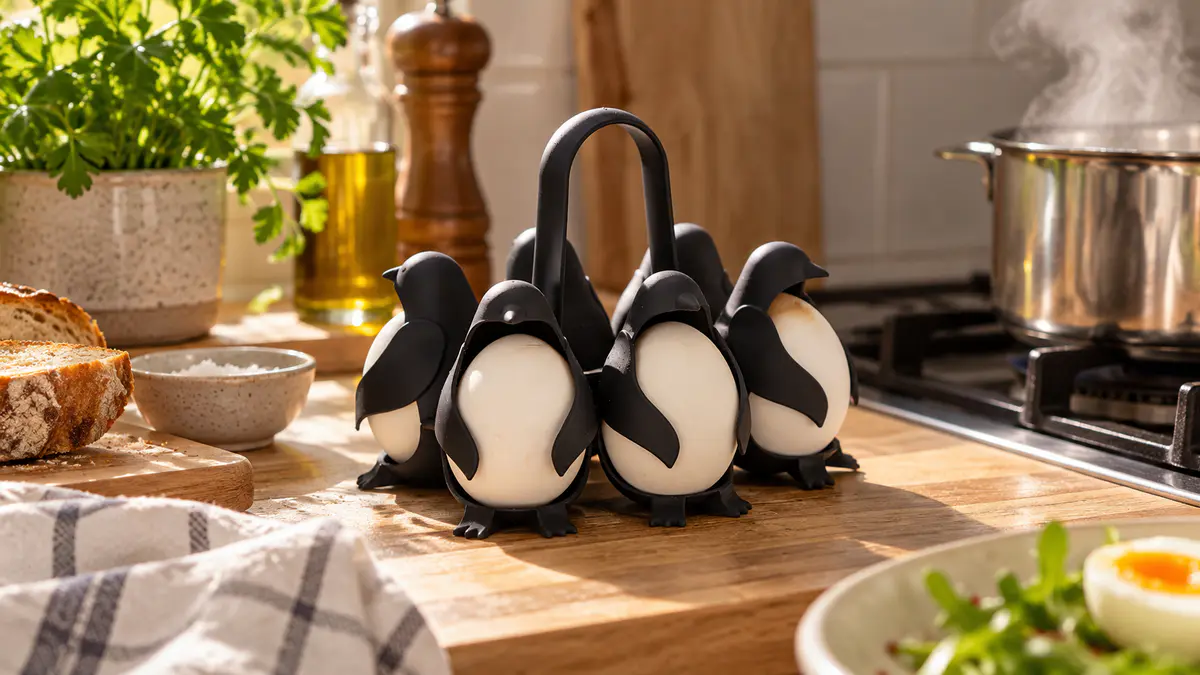
According to the manufacturer, the holder is designed for cooking, serving, and storing eggs. The frame is intended to make handling several eggs at once more convenient, while the heat-resistant handle helps with lifting it from a pot when used as directed.
The concept is wonderfully unnecessary-looking. After all, people have been boiling eggs without penguin-shaped accessories for a very long time. But Egguins does offer something beyond decoration. Grouping the eggs in a holder can make it easier to transfer several at once, while also providing an organized place to keep them afterward.
Its usefulness depends on your routine.
If you routinely boil half a dozen eggs, a holder that moves them as a group could be convenient. If you usually cook one egg, or rarely boil them at all, most of the device will spend its time waiting for an occasion. It also takes up room in the pot. You need to check the size of your cookware, and the manufacturer notes that the holder is best suited to large eggs. And despite the appealing imagery, you still need to handle boiling water carefully. Cute penguins don’t change the rules of kitchen safety.
What makes Egguins memorable is that it doesn’t demand a choice between usefulness and humor. It offers a modest practical function, wrapped in a visual joke that might make somebody smile before breakfast.
Will it revolutionize how you cook eggs? Almost certainly not. But a colony of penguins holding breakfast together is a much more delightful solution than most people would have thought to invent.
Which Weird Kitchen Gadgets Are Actually Worth Having?
The awkward truth about kitchen gadgets is that almost every one of them solves a real problem. That doesn’t mean every problem deserves a dedicated tool.
A chicken shredder might be useful when preparing several portions of cooked meat, but unnecessary for an occasional sandwich. A specialty egg peeler becomes easier to justify when boiled eggs are part of a weekly routine. A vegetable curler might be delightful for someone who enjoys food presentation, while remaining untouched in another person’s drawer.
The difference isn’t always in the product. Often, it’s in the person using it. A useful way to judge any unusual kitchen tool is to ask four questions:
- How frequently does the problem occur?
- Does the tool meaningfully improve the task, or simply make it more entertaining?
- How difficult is it to wash and store afterward?
- Could something already in the kitchen accomplish the same job?
The last question is particularly important.
Angry Mama can help soften dried microwave residue, but so can a bowl of heated water. The Fluicer changes the effort involved in squeezing citrus, while Chop2Pot changes the way chopped ingredients move from one place to another.
Gracula, Karoto, and Egguins offer a different kind of improvement. Their usefulness is partly functional and partly emotional: they make an ordinary activity more amusing, memorable, or satisfying.
None of these advantages should be exaggerated.
A tool that saves a little time but creates more washing up isn’t automatically an improvement. Neither is a gadget that looks wonderful in photographs but never leaves its drawer.
Still, treating amusement as worthless would be just as narrow-minded as treating novelty as proof of quality. A kitchen is a place where practical work happens, but it is also a place people spend an enormous amount of their lives. There is room for a little personality, provided it doesn’t constantly get in the way.
Why Do Strange Kitchen Gadgets Feel So Irresistible?
Much of cooking is repetition. We chop the same vegetables, reach for the same pans, wash the same utensils, and repeat familiar movements until we barely notice them. A strange kitchen gadget interrupts that pattern.
A carrot belongs in a pencil sharpener. A vampire crushes garlic. A small family of penguins appears in a saucepan. The ordinary task suddenly becomes something worth looking at again.
It’s also easy to imagine these products in action. Unlike purely decorative objects, kitchen gadgets arrive with a little story already attached: a mess they might prevent, a frustration they might remove, or a reaction they might provoke.
That combination of practical purpose and unexpected design helps explain why strange products can remain interesting even when their usefulness is limited. It’s part of the wider question explored in Why Some of the World’s Strangest Products Keep Selling. Novelty wins attention. Whether a product earns a permanent place in our lives is a separate matter.
A Little Weirdness Has Its Place
Not every kitchen problem needs an invention.
Sometimes the best solution is still a knife, two forks, or a bowl that’s already sitting in the cupboard. Other times, a strange-looking tool really does offer a smarter way to do something familiar.
And occasionally, the practical improvement is small, but the pleasure of using the object is real. The trick is knowing which one you’re buying.
The most interesting kitchen gadgets don’t necessarily make cooking faster. They make us reconsider a familiar movement, a neglected inconvenience, or an everyday object we’ve stopped noticing.
That’s worth appreciating, even when it’s not worth buying. And if a vampire makes crushing garlic a little more entertaining, perhaps there’s room for him in the drawer after all.
For more unusual objects that balance absurdity with practical purpose, explore 10 Strange Objects That Make More Sense Than They Should.