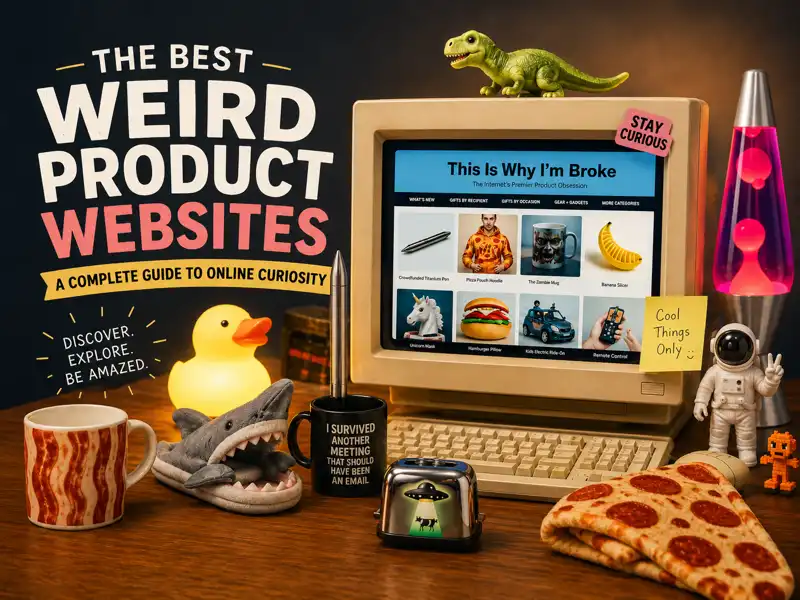
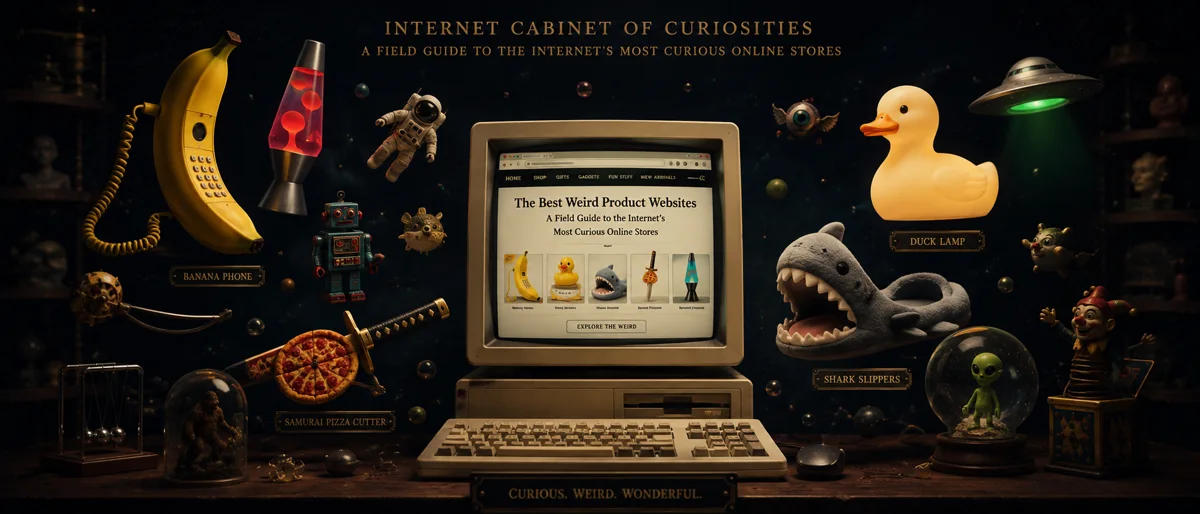
From internet legends to hidden gems, explore the websites that have shaped weird product culture for more than two decades.
The internet has always had a place for the unexpected.
Long before algorithms learned what we liked, and years before TikTok turned unusual gadgets into overnight sensations, there were websites dedicated to one simple idea: collecting things that made people stop, smile, and ask, “Who on earth made this?”
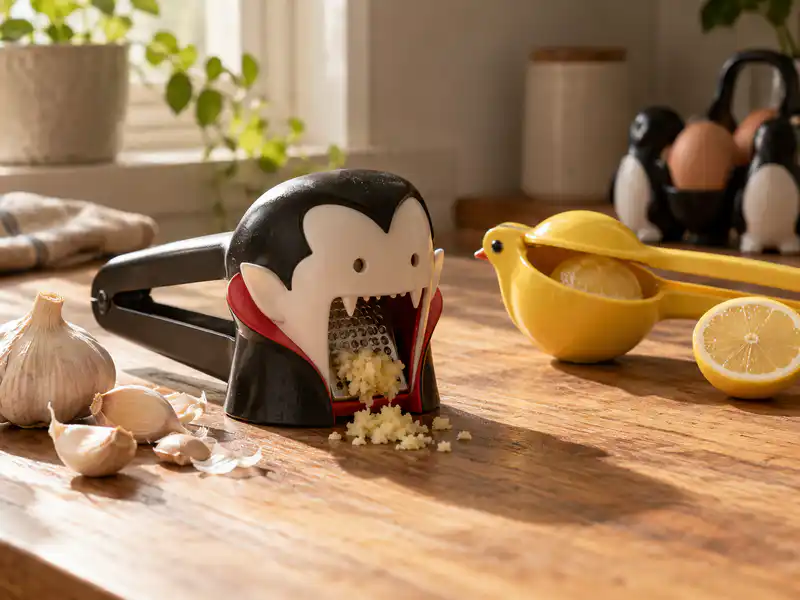
They weren’t traditional online stores. They weren’t product review sites either. Instead, they became digital cabinets of curiosity—places where a banana-shaped telephone could appear next to a medieval-style pizza cutter, or a lamp inspired by a duck might sit beside a completely impractical invention that nobody actually needed. Most visitors didn’t arrive with a shopping list. They came for the experience of discovery.
Scroll after scroll, these websites rewarded curiosity rather than efficiency. You rarely knew what was coming next, and that uncertainty was exactly what made them so compelling.
Today, strange products are everywhere. Social media feeds, online marketplaces, and AI recommendations surface unusual items every day. Yet many of those discoveries can be traced back to a small group of websites that quietly shaped this corner of internet culture long before “viral products” became a trend.
This guide explores those websites—not simply as places to buy unusual things, but as pioneers of curiosity-driven discovery on the web.
What Is a Weird Product Website?
Imagine opening a website with no intention of buying anything.

Five minutes later, you’ve gone from a banana-shaped telephone to a medieval pizza cutter, then somehow found yourself reading about a lamp that looks like a duck. Another click leads to a pair of fish-shaped slippers. A few minutes after that, you’re looking at an unnecessarily elaborate coffee mug that nobody needs—but somehow you still want to show it to a friend.
Somewhere along the way, you stop thinking about shopping altogether. You’re simply exploring.
That experience is surprisingly familiar to anyone who has spent time on websites like This Is Why I’m Broke or OddityMall. Visitors rarely arrive with a shopping list, and many leave without purchasing a single product. Yet they often stay far longer than they intended because every page offers another small surprise. The experience is driven not by necessity, but by curiosity.
This is what makes weird product websites different from almost every other form of online shopping.
More Than an Online Store
At first glance, these websites appear to be ordinary e-commerce destinations. They display product photographs, organize items into categories, and often link directly to retailers where those products can be purchased. From a distance, there is little to distinguish them from thousands of other shopping websites.
Spend a little more time browsing, however, and their purpose becomes much less obvious. Traditional online stores are designed to solve problems as efficiently as possible. A visitor arrives looking for a specific product, compares a handful of options, and leaves once the purchase is complete. Success is measured by how quickly someone moves from search to checkout.
Weird product websites follow a completely different philosophy. Rather than helping visitors find something they already need, they encourage them to discover things they never expected to see. The longer someone explores, the more successful the experience becomes. In that sense, browsing is not simply a step before buying—it is the product itself.
A Genre That Exists Between Several Worlds
One reason these websites are so difficult to define is that they don’t fit comfortably into any single category. Instead, they combine characteristics from several different kinds of websites, borrowing ideas from publishing, e-commerce, and digital media while developing an identity of their own.
An online magazine recommends stories through editorial judgment; a weird product website recommends objects in much the same way. Discovery platforms encourage people to stumble across unexpected ideas; these websites create that same sense of accidental discovery through carefully selected products. Their business models often resemble affiliate websites, yet the browsing experience feels closer to reading a publication than comparing prices. At the same time, they function as curated collections and gift guides, inspiring visitors long before they ever think about making a purchase.
No single comparison fully captures what these websites are. Instead, they combine elements of publishing, commerce, and curated discovery to create a browsing experience unlike any traditional online store.
A Digital Museum of Curiosity
Perhaps the closest comparison isn’t a shopping website at all.
It’s a museum.
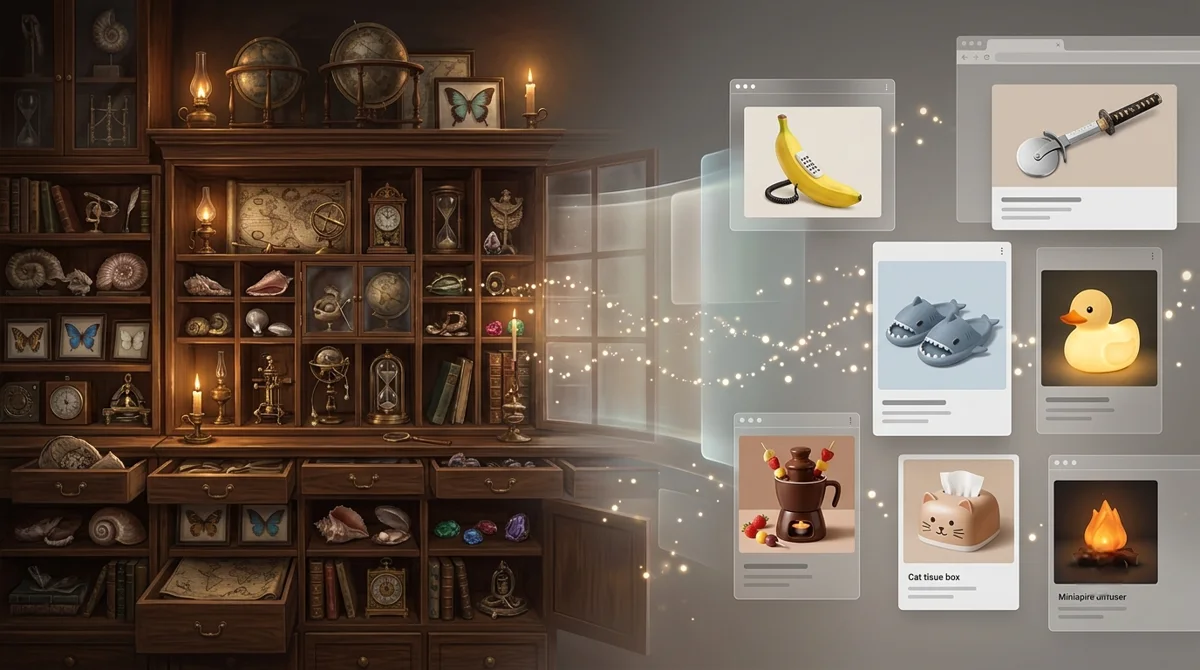
Long before the internet, collectors assembled what became known as cabinets of curiosities—rooms filled with remarkable objects gathered from around the world. Scientific instruments, unusual fossils, mechanical inventions, rare artifacts, and beautifully crafted oddities were displayed side by side, not because they served a practical purpose, but because they inspired wonder. Visitors wandered from object to object without following a particular route, allowing curiosity to determine where they looked next.
The best weird product websites recreate that same experience in digital form. Instead of historical artifacts, they display strange inventions, clever gadgets, unusual home décor, novelty gifts, and products that exist somewhere between thoughtful design and delightful absurdity. Every listing becomes another exhibit, while the collection itself reflects something larger about creativity, humor, and the endless imagination of people who continue inventing things the rest of us never expected to exist.
Thinking of these websites as digital museums of curiosity helps explain their lasting appeal. Like a museum, they invite visitors to wander freely, discovering one unexpected object after another without a fixed destination.
Curated, Not Collected
One of the most common misconceptions about weird product websites is that their success comes from featuring as many unusual products as possible. In reality, quantity has rarely been their defining characteristic. The websites that people remember years later are not necessarily those with the largest catalogs, but those with the strongest editorial taste.
Behind every homepage is a series of editorial decisions about which products deserve attention. Those choices—not the total number of listings—are what define the quality of a weird product website.
Discovery Before Search
The easiest way to understand this niche is to compare search with discovery.
Most online shopping begins with certainty. A person already knows what they need, types it into a search box, compares a handful of options, and completes a purchase. The website succeeds by reducing friction and helping visitors reach their destination as quickly as possible.
Weird product websites begin from the opposite direction. Visitors often have no idea what they are looking for because finding a particular product is never the primary objective. Instead, they are searching for a feeling—the small moment of surprise that comes from encountering something unexpected. Every recommendation exists to extend that feeling, encouraging another click, another discovery, and another moment of curiosity.
Unlike algorithm-driven platforms, these websites rely on human editorial choices to shape the browsing experience. That difference gives every collection a distinctive character that feels intentional rather than automatically generated.
Our Working Definition
Unlike terms such as online marketplace or comparison shopping website, “weird product website” has no universally accepted definition. It is an informal phrase that has gradually emerged through years of internet culture to describe a recognizable type of online destination.
Rather than describing a specific business model, the term refers to a distinctive browsing experience—one built around curiosity, editorial curation, and unexpected discovery instead of intentional shopping.
The websites explored in the following sections all interpret this idea differently, but each demonstrates how curiosity can become the foundation of an unforgettable browsing experience.
How We Evaluated These Websites
About This Guide
Rather than ranking websites by traffic, affiliate revenue, or popularity, we examined how they approached discovery, curation, and editorial storytelling. Wherever possible, we also reviewed archived versions to better understand how these websites evolved over time.
Every list reflects the choices of the people who create it.
That is especially true for weird product websites, where popularity alone tells only a small part of the story. Some of the most influential websites in this niche are no longer updated regularly. Others have changed ownership, shifted their editorial direction, or quietly disappeared despite leaving a lasting impact on how unusual products are discovered online.
For that reason, we chose not to rank websites by monthly traffic, the number of products they feature, or how often they publish new content. While those metrics are useful, they say very little about why certain websites continue to be remembered years after individual products have disappeared.
Instead, we evaluated each website through a broader editorial lens. Our research considered how products are curated, how discovery is encouraged, how the browsing experience is designed, and whether a website has developed a recognizable editorial identity over time. We also looked at its longevity, reputation within the niche, and its influence on later generations of weird product websites.
Whenever possible, we explored each website directly rather than relying on secondary sources. We compared archived content, observed how websites had evolved over time, and looked for recurring editorial patterns instead of isolated examples. The goal was not simply to understand what each website publishes today, but what role it has played in shaping this unusual corner of the internet.
Our Evaluation Framework
Throughout this guide, every website is considered using the same editorial principles:
Curation — Does it thoughtfully select products instead of simply collecting them?
Discovery — Does browsing encourage curiosity rather than direct shopping?
Editorial Identity — Does the website have a recognizable voice or perspective?
Cultural Influence — Has it shaped or inspired the weird product niche?
Longevity — Has it remained relevant or historically significant over time?
Rather than assigning scores, we use these principles to understand why each website matters within the broader history of weird product discovery.
From Search to Serendipity: How Weird Product Websites Changed Online Discovery
The history of weird product websites is not simply the history of a niche category of online stores. It is, in many ways, the history of how the internet learned to reward curiosity.
Long before recommendation algorithms shaped what people saw on social media, and before artificial intelligence could answer almost any shopping question in seconds, discovering something unusual required a different kind of effort. People had to wander through blogs, follow links shared on forums, subscribe to newsletters, or stumble across websites maintained by enthusiasts who enjoyed collecting remarkable things. Discovery was slower, less predictable, and often far more memorable because it depended on human curiosity rather than machine prediction.
Weird product websites emerged from that environment. They offered something search engines could never provide: the opportunity to discover something you never thought to search for.
Discovery Before Algorithms
In the early years of the modern web, search engines fundamentally changed how people found information. They made the internet searchable, organized, and remarkably efficient. If you knew what you wanted, the web could usually help you find it.
But efficiency came with an unexpected limitation, Search works best when people already know the question they want to ask; Curiosity rarely works that way. Most memorable discoveries begin without a keyword. They begin with surprise. That gap created space for a completely different kind of website.
Rather than waiting for visitors to type the right phrase into a search box, websites such as This Is Why I’m Broke and later OddityMall embraced a different philosophy. Instead of helping people search more efficiently, they encouraged them to browse more openly. The homepage itself became an invitation to explore, where every scroll promised another unexpected object that might be amusing, ingenious, beautifully designed, or wonderfully unnecessary.
For the first time, curiosity alone became enough of a reason to visit a website.
The Rise of Human Curation
As more websites entered the niche, something interesting happened, Their greatest value wasn’t the products themselves.
The best weird product websites never attempted to catalogue every unusual item available online. Instead, they acted as editors, filtering an overwhelming internet into collections that reflected humor, creativity, craftsmanship, and personality. Visitors gradually learned to trust that someone had already done the searching on their behalf.
That editorial relationship became one of the defining characteristics of the niche. Readers weren’t simply following links; they were following taste. Every homepage reflected thousands of invisible decisions about what deserved attention and what could safely be ignored.
In retrospect, these websites were among the internet’s earliest examples of human-curated discovery. Long before algorithms learned to predict what people might enjoy, editors were already introducing readers to products they never imagined existed.
When Discovery Became Entertainment
One reason weird product websites remained popular for so many years is that they quietly transformed shopping into entertainment.
Traditional e-commerce begins with a need and ends with a purchase. Weird product websites reversed that sequence. People often arrived with no intention of buying anything, yet happily spent thirty minutes scrolling through products they would probably never own. The pleasure came from the experience itself—the next strange invention, the next clever design, the next object interesting enough to send to a friend with the message, “You have to see this.”
In many ways, these websites anticipated behaviors that later became central to platforms such as Pinterest, Instagram, and TikTok. Endless scrolling, visual storytelling, highly shareable discoveries, and browsing driven by curiosity rather than necessity all became defining features of modern social media.
The difference is that social platforms optimize for attention, Weird product websites optimize for exploration.
One asks, “What will keep people watching?” The other asks, “What is genuinely worth discovering?” Those are similar experiences—but they are not the same.
Why They Survived the Social Media Era
When social media became the internet’s primary discovery engine, many people assumed websites dedicated to unusual products would gradually disappear. Instead, the opposite happened.
Although viral trends increasingly originated on social platforms, dedicated weird product websites continued to play a different role. Rather than competing to publish the newest viral gadget, they became archives of discovery—places where remarkable products remained accessible long after they had disappeared from algorithmic feeds.
That distinction matters more than it first appears, Algorithms are designed to prioritize what is popular today. Curated websites preserve what remains interesting tomorrow,One is driven by recency, The other is guided by judgment.
As a result, these websites accumulated something social platforms rarely achieve: a lasting editorial identity. Visitors often returned not because they remembered a particular product, but because they trusted the people behind the collection.
The AI Era and the Return of Editorial Judgment
Artificial intelligence is changing online discovery once again, Instead of searching through pages of results or scrolling endlessly through social feeds, people increasingly ask conversational questions and expect immediate recommendations. AI can compare products, summarize reviews, and generate gift ideas within seconds. Yet the rise of AI also highlights something that weird product websites have quietly demonstrated for years.
Recommendations are not the same as curation.
An AI system can efficiently answer the question, “What unusual gifts should I buy?” It is much less capable of recreating the pleasure of wandering through a thoughtfully assembled collection where every click leads somewhere unexpected.
The value of these websites has never been efficiency. It has always been serendipity.
As algorithmic recommendations become increasingly personalized, genuinely human editorial judgment may become even more valuable precisely because it is unpredictable. Curiosity often grows from encountering someone else’s perspective rather than having our own preferences endlessly reflected back to us.
Why This History Still Matters
Seen individually, a novelty lamp or an absurd kitchen gadget may seem trivial,Seen together, thousands of these products tell a much larger story about the evolution of the web. They remind us that discovery was never only about technology. It has always depended on people willing to collect interesting things, organize them thoughtfully, and share them with strangers who enjoy being surprised.
That is the tradition weird product websites continue to preserve.
They represent a chapter of internet culture built not around efficiency, optimization, or endless personalization, but around exploration, curiosity, and the simple pleasure of finding something unexpected. Technology will continue to evolve. Search engines will improve, social platforms will change, and artificial intelligence will almost certainly reshape the way people discover products in the years ahead. What is unlikely to change is the human desire to wonder.
And as long as curiosity remains part of the online experience, there will always be a place for websites that invite people to explore without knowing exactly what they are looking for.
What Makes a Weird Product Website Worth Returning To?
Finding unusual products is easy, Building a website that people genuinely want to revisit is much harder.
Every day, thousands of novelty items appear across online marketplaces. Many are creative, some are amusing, and a few briefly become viral sensations before disappearing almost as quickly as they arrived. If collecting strange products were enough, every online marketplace would feel as engaging as the best weird product websites.
Yet they don’t. The difference lies not in the products themselves, but in the experience surrounding them. After researching dozens of websites for this guide, one pattern became increasingly clear: the most memorable destinations are not simply collections of unusual objects. They are carefully curated experiences that encourage people to slow down, explore, and enjoy the process of discovery.
Although every website approaches that goal differently, the strongest examples consistently share several characteristics that distinguish them from ordinary affiliate sites and conventional online stores.
Curation Creates Value
One of the biggest misconceptions about weird product websites is that success comes from publishing as many unusual products as possible. In reality, quantity has rarely been their defining strength. The internet already contains an almost limitless supply of novelty products; simply displaying more of them adds very little value.
What visitors remember is judgment.
The best websites create the feeling that someone has already searched through thousands of products and selected only those worth a second look. Every featured item earns its place because it is genuinely creative, unexpectedly clever, beautifully designed, or simply impossible to ignore.
This process of selection transforms browsing into an editorial experience. Readers are no longer relying on search results or recommendation algorithms. Instead, they are relying on the taste and curiosity of another human being. Over time, that editorial judgment becomes one of the website’s most valuable assets.
Great discovery begins not with collecting everything, but with knowing what to leave out.
Discovery Comes Before Shopping
Traditional e-commerce is built around intention. Visitors know what they need, search for it, compare a handful of options, and complete a purchase as efficiently as possible. Every design decision supports that goal.
Weird product websites reverse the entire journey.
Most visitors arrive without a shopping list. They are not looking for a specific gadget or gift. They are looking for the experience of finding something unexpected. One unusual product naturally leads to another until browsing itself becomes the reason for staying. This difference explains why so many successful websites in the niche feel surprisingly immersive. They encourage wandering rather than searching, allowing curiosity to shape the experience instead of urgency.
Purchases may eventually happen, but they are rarely the starting point.
Every Great Website Has an Editorial Personality
Products can be copied. Editorial taste cannot.
Two websites may recommend many of the same products while leaving completely different impressions on their readers. One may focus on geek culture and engineering, another on playful home décor, and another on absurd inventions that exist purely for entertainment. Those differences are rarely accidental. They reflect thousands of editorial choices made over months and years.
Visitors begin to recognize those choices, often without realizing it. They return because they trust the perspective behind the collection as much as the collection itself. This is one of the reasons the best weird product websites feel more like magazines than catalogs. Their personality does not come from logos or color palettes, but from the consistent decisions about what deserves attention.
In the long run, people remember editors more than inventories.
Context Makes Products Memorable
A strange object is interesting for a moment. A story makes it memorable.
The strongest weird product websites rarely present products as isolated items. Instead, they provide enough context for readers to understand why an object exists, what inspired its design, or why it became popular in the first place. Even a completely impractical invention becomes more engaging when it is connected to a broader idea about creativity, humor, or everyday life.
Context also changes the relationship between readers and products. Instead of asking, “Should I buy this?” visitors often begin by asking, “Who thought of this?” or “Why does this even exist?” Those questions encourage exploration rather than comparison, turning ordinary browsing into something closer to reading.
In many cases, the story surrounding a product outlasts the product itself.
Human Judgment Still Matters
Over the past two decades, online discovery has changed dramatically. Search engines made information easier to find. Social media accelerated the spread of viral products. Artificial intelligence is now capable of generating recommendations in seconds.
Algorithms excel at predicting what people are likely to click based on past behavior. Editors often do something entirely different. They introduce readers to ideas they would never have searched for because those ideas fall outside existing patterns of interest. That distinction may become even more important in the years ahead.
As recommendations become increasingly personalized, editorial curation offers something algorithms cannot easily reproduce: surprise. It exposes people to perspectives beyond their own preferences and reminds them that curiosity often begins with encountering someone else’s taste. For websites built around discovery, that human perspective remains one of their greatest strengths.
More Than a Collection of Products
Seen individually, these characteristics may appear relatively simple. Together, however, they explain why some weird product websites continue attracting loyal audiences year after year while others quietly fade away.
The most successful examples are not defined by how many products they feature or how often they publish new content. They succeed because they create an experience that readers want to return to—one shaped by thoughtful curation, editorial personality, meaningful context, and a genuine respect for curiosity. In many ways, these websites have always offered something larger than shopping. They preserve a style of exploring the internet that values wandering over searching, surprise over certainty, and human judgment over automated prediction.
As we begin examining individual websites in the next chapter, these ideas provide a useful lens through which to understand their differences. Rather than asking which website has the largest catalog or the most traffic, we will ask a more meaningful question:
What has each website contributed to the culture of online curiosity?
The Websites That Built a Culture
The Evolution of Weird Product Websites
1999–2005
The Early Curiosity Web
Personal blogs · Forums · Link directories · StumbleUpon · Digg
2006–2012
The Golden Age of Curated Discovery
This Is Why I’m Broke · DudeIWantThat · OddityMall · Wanelo · Human editors
2013–2018
Content + Commerce
Affiliate marketing · BuzzFeed Shopping · Pinterest · SEO · Long-form editorial
2019–Today
Algorithmic Discovery
TikTok · Instagram · YouTube Shorts · AI recommendations · Creator economy
The Pioneer of Curiosity-Driven Discovery
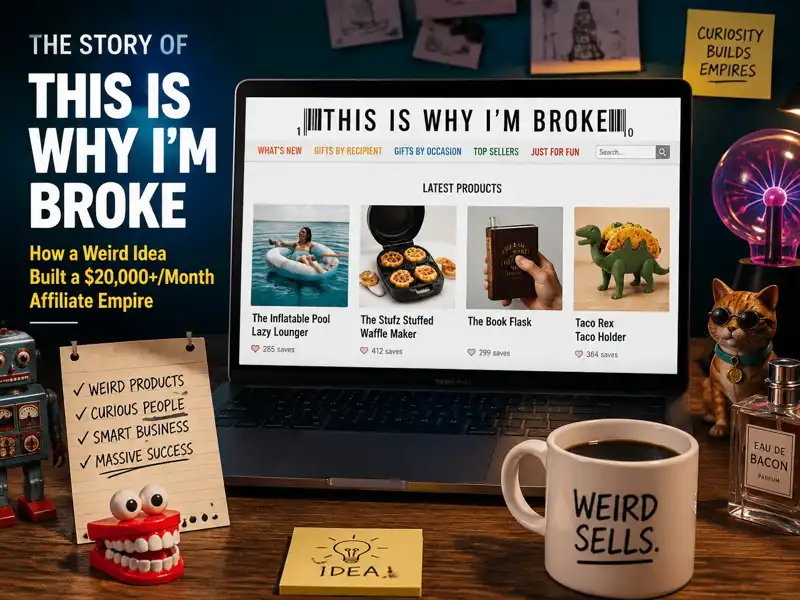
This Is Why I’m Broke
The website that proved browsing unusual products could be entertaining, memorable, and commercially sustainable.
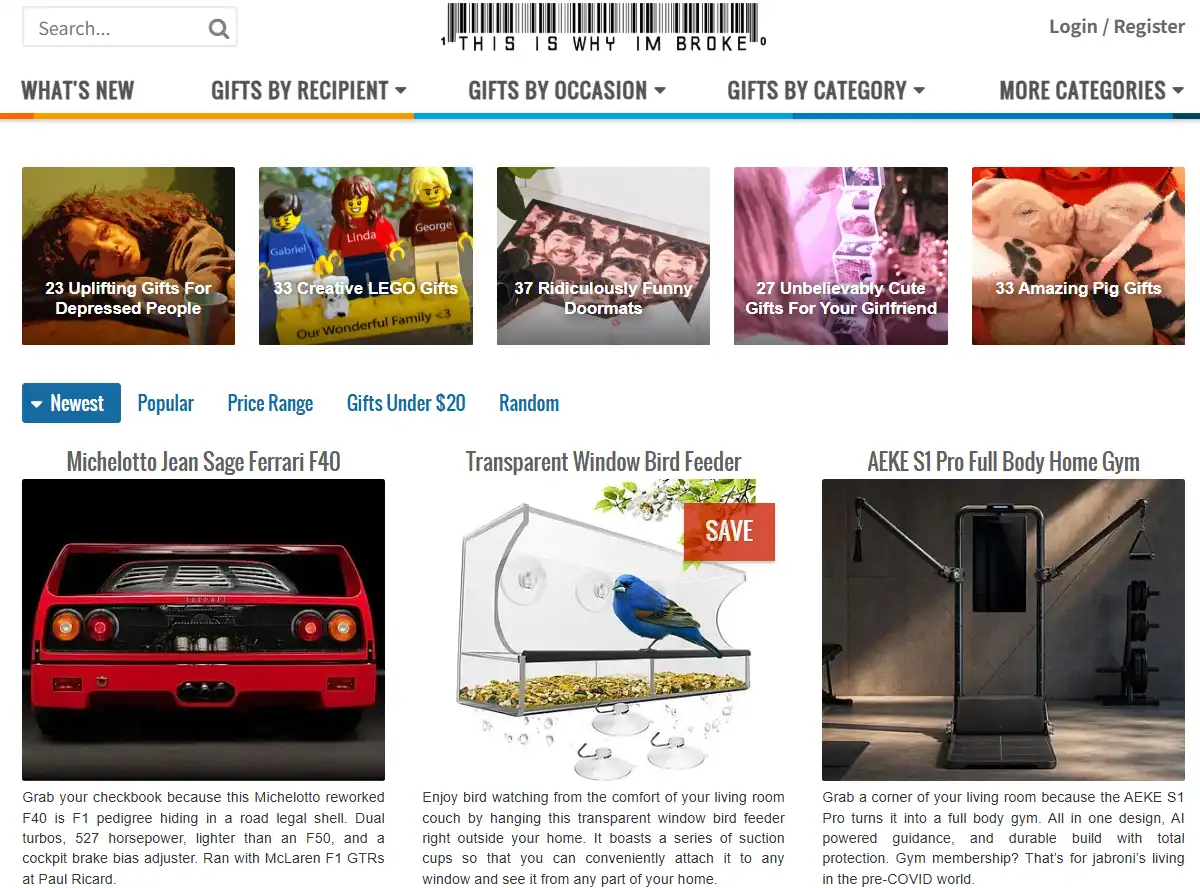
Every niche has a publication, platform, or community that comes to define it. Within the world of weird product discovery, that role is difficult to separate from This Is Why I’m Broke. Although countless websites have featured novelty gifts, quirky gadgets, and bizarre inventions over the years, few have influenced the way people experience those products as profoundly. Its importance lies not simply in the number of items it has published, but in the way it changed expectations. Its real contribution was changing how unusual products were presented online. Instead of treating them as isolated purchases, it turned discovery itself into the main attraction.
Looking back today, it is easy to forget how different this idea once felt. Modern social platforms have conditioned us to scroll endlessly through algorithmic recommendations, but This Is Why I’m Broke was cultivating a remarkably similar sense of discovery long before personalized feeds became the dominant way of navigating the internet. Visitors arrived because they were curious, stayed because they were continually surprised, and often returned simply to see what strange object might appear next.
More Than an Affiliate Website
At first glance, it would be easy to describe This Is Why I’m Broke as an affiliate website. It recommends products sold by other retailers and earns revenue when readers decide to purchase them. Technically, that description is accurate, yet it misses the characteristic that made the website influential in the first place.
For readers interested in how this publishing model translated into a highly successful affiliate business, our in-depth case study explores the website’s growth strategy, business model, and long-term influence in greater detail.
Unlike traditional affiliate websites built around search intent, This Is Why I’m Broke introduced a different publishing model. Its competitive advantage was not product access, but the ability to package ordinary products into memorable discoveries through selection, presentation, and timing.
This distinction is subtle but important. The website is not organized around purchasing decisions; it is organized around moments of curiosity.
The Power of Editorial Curation
Its lasting influence came from demonstrating that selection itself could become a form of value. In an internet increasingly defined by abundance, the website proved that knowing what to highlight was sometimes more important than having more products.
That editorial restraint creates consistency. After spending time on the website, readers develop confidence that nearly every page will contain at least one object worth sharing, laughing at, or remembering. The trust they place in the collection gradually shifts away from individual products and toward the editorial judgment behind them. In other words, visitors return because they believe someone else has already done the difficult work of separating genuinely interesting discoveries from the overwhelming volume of novelty products available online.
This may be the website’s most significant contribution to the niche. It demonstrated that thoughtful curation could become a competitive advantage in its own right.
A Browsing Experience Designed for Curiosity
One of the website’s lasting contributions was proving that browsing behavior itself could become a valuable digital experience. At a time when most online shopping journeys focused on efficiency and conversion, This Is Why I’m Broke showed that exploration could also become a reason for people to return.
This idea became increasingly relevant as online discovery evolved. Although today’s internet is dominated by recommendation algorithms, the fundamental appeal remains strikingly similar. People still enjoy encountering ideas they never expected to find, and they still appreciate the feeling that each click might reveal something completely different from the last. What has changed is the mechanism behind those discoveries. On social platforms, algorithms increasingly decide what deserves attention. On This Is Why I’m Broke, that responsibility continues to rest with human editors.
Why Its Influence Still Matters
Its broader influence came from proving that affiliate publishing did not have to imitate traditional e-commerce. A website built around taste, selection, and entertainment could create a recognizable audience without competing on inventory or price.
This lesson has become increasingly relevant as discovery moves toward algorithmic systems. As discovery becomes more personalized and efficient, the value of thoughtful editorial curation becomes easier—not harder—to recognize. Algorithms excel at predicting existing interests, but they rarely recreate the pleasure of unexpectedly stumbling across something that expands those interests altogether.
Our Perspective
While researching this guide, one observation became impossible to ignore. Many newer websites have successfully reproduced the visual structure of This Is Why I’m Broke, borrowing its grid layouts, concise descriptions, and affiliate-driven business model. Far fewer have managed to reproduce the quality that actually made the website memorable: its editorial judgment. Layouts can be copied, affiliate programs are open to everyone, and even product selections inevitably overlap. What cannot be replicated so easily is the ability to consistently recognize which discoveries are genuinely worth another person’s attention.
Its greatest legacy was proving that editorial judgment could become the foundation of a recognizable digital business.
Legacy
This Is Why I’m Broke’s lasting contribution was not a specific format or product category, but a shift in how people understood online discovery. It showed that curation itself could become a reason to visit, share, and return.
Whether through curation, storytelling, visual browsing, or editorial voice, the influence of This Is Why I’m Broke can still be seen across today’s weird product ecosystem.
Curator’s Note
While This Is Why I’m Broke established the foundations of the niche, the next pioneer expanded the idea by placing far greater emphasis on storytelling and themed collections.
Editorial Note
If This Is Why I’m Broke established the idea that browsing unusual products could become entertainment, the next generation of websites began asking a different question: Could discovery become richer through storytelling?
Rather than relying primarily on the excitement of finding another strange object, some publishers started adding context, themed collections, and longer editorial descriptions that encouraged readers to stay even longer.
No website represents that evolution better than OddityMall.
The Storyteller
OddityMall
The website that demonstrated how thoughtful storytelling could transform product discovery into an editorial experience.
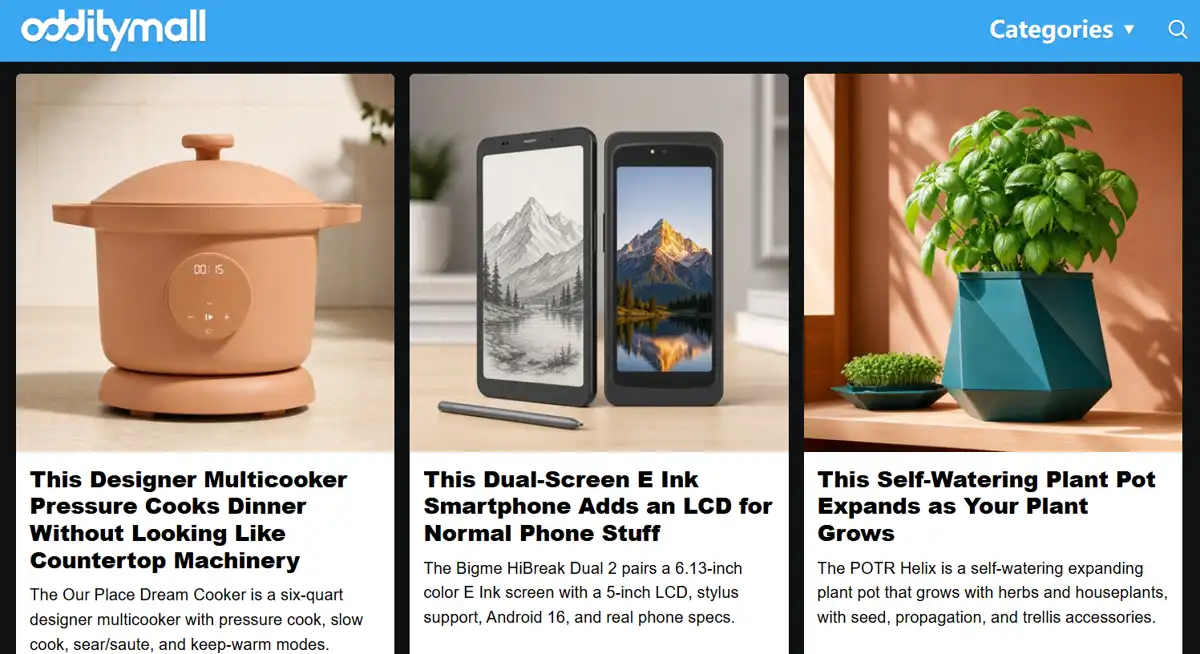
If This Is Why I’m Broke established the idea that browsing unusual products could become entertainment, OddityMall helped demonstrate that the same experience could become more immersive through stronger editorial curation. Rather than focusing primarily on rapid discovery, OddityMall became known for adding stronger editorial context, thematic collections, and longer explanations that encouraged readers to spend more time with each recommendation.
That distinction may appear subtle, but it fundamentally changes the browsing experience. Instead of relying primarily on novelty to sustain attention, OddityMall creates a stronger sense of narrative continuity. Readers are invited to move through categories and collections that feel intentionally assembled, making the website resemble an editorial publication far more than a traditional affiliate catalog.
Editorial Curation Over Endless Discovery
OddityMall strengthened the role of editorial organization by presenting products as parts of larger collections rather than isolated recommendations.A creative kitchen gadget sits naturally alongside other inventions that reflect the same playful spirit, while imaginative home décor, quirky furniture, and unconventional gifts are grouped in ways that encourage readers to explore an entire subject rather than a single listing.
This approach gives browsing a stronger sense of direction without sacrificing the pleasure of discovery. Visitors are still surprised by individual products, but those surprises unfold within a recognizable editorial framework. As a result, the experience feels less like wandering through an enormous marketplace and more like reading a carefully planned magazine issue in which every recommendation contributes to a larger idea.
Building a Lasting Editorial Identity
Because of this emphasis on context and organization, OddityMall has developed a recognizable editorial identity that extends well beyond its visual design. Readers gradually become familiar with the website’s perspective, not because every recommendation shares the same style, but because the collections consistently reflect a similar way of looking at creativity, humor, and everyday life. Over time, that consistency builds trust, allowing visitors to rely on the editorial judgment behind the website rather than on the popularity of any individual product.
That stronger editorial context encouraged readers to treat product pages as content worth reading rather than simply stepping stones toward external retailers.
This is an important distinction within the broader weird product niche. Because that identity remained consistent over time, the website became memorable even as individual products changed.
Why It Matters
OddityMall’s historical contribution was demonstrating that editorial storytelling could become a competitive advantage alongside product selection, influencing many later discovery websites.
Its contribution is therefore best understood not as a technological innovation but as an editorial one. It reinforced the idea that people are often just as interested in understanding the story behind an unusual product as they are in purchasing it.
Legacy
OddityMall demonstrated that thoughtful storytelling and thematic organization could become lasting editorial advantages, extending the idea of curiosity-driven discovery beyond simple product recommendation.
Editorial Note
By now, a clear pattern has emerged, The pioneers of weird product discovery did not compete by offering exclusive products. In fact, many of them featured items that could also be found elsewhere on the internet. What made them memorable was the experience they created around those products.
Some emphasized endless discovery. Others invested heavily in storytelling. The next website added another dimension that would prove just as influential: personality.
Because readers don’t just remember what a website recommends. They remember how it makes them feel.
The Personality Behind the Products
DudeIWantThat
A discovery website that demonstrated how a clearly defined audience could become an editorial advantage.
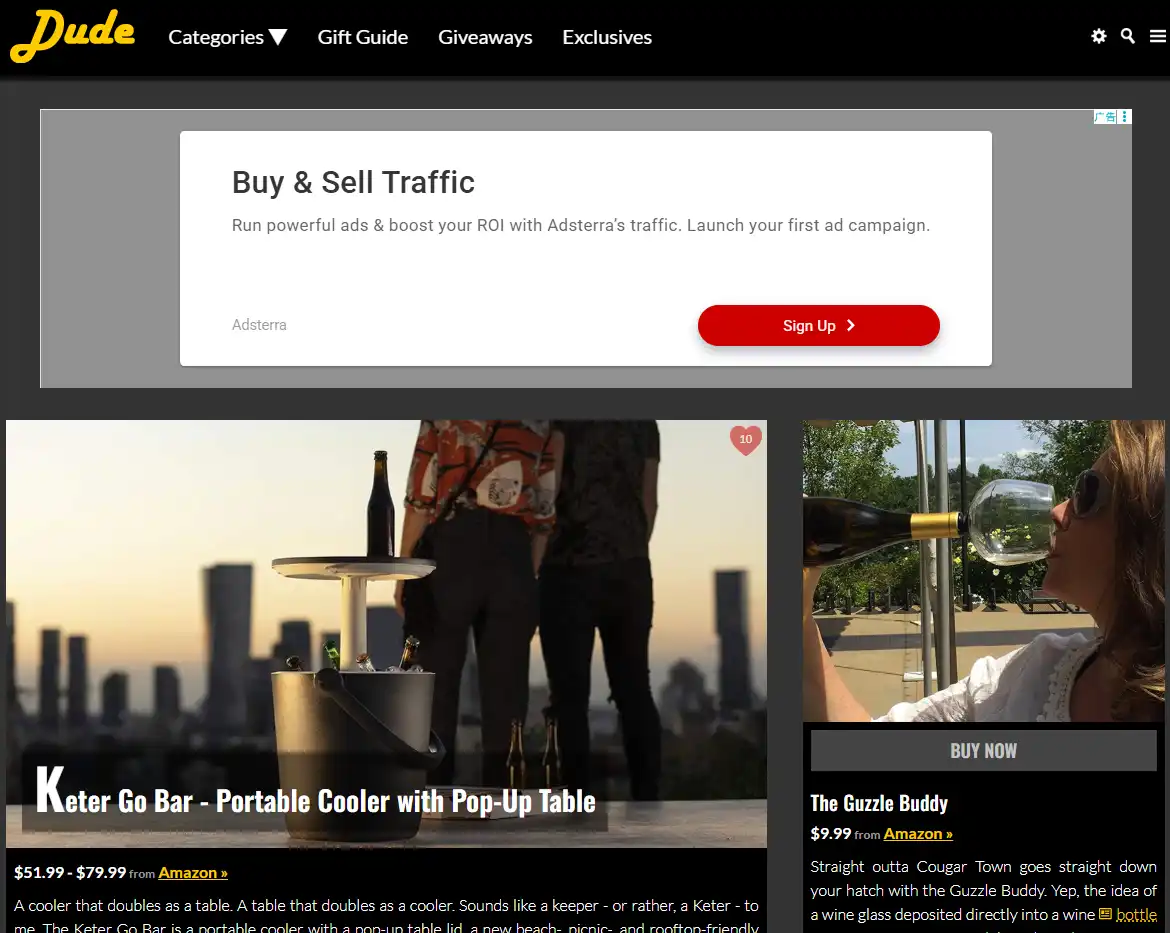
DudeIWantThat distinguished itself by building a recognizable editorial personality around a specific audience rather than trying to appeal to everyone. Its recommendations consistently reflected interests such as gadgets, engineering, gaming, science fiction, and maker culture.
That decision shaped far more than the products it featured. It influenced the language, the humor, the editorial tone, and even the kinds of conversations the website encouraged. Over time, visitors were not simply returning because they expected another unusual recommendation; they were returning because the recommendations reflected a perspective they recognized and enjoyed. In an increasingly crowded niche, that sense of editorial identity became one of the website’s greatest strengths.
Curation Through Audience Rather Than Category
DudeIWantThat approaches curation from a different direction. Instead of beginning with product categories, it begins with the interests of the people reading the website.Instead of organizing products around retail categories, DudeIWantThat curated recommendations around a shared audience with similar interests and tastes.
This subtle shift changes the browsing experience in meaningful ways. Readers are no longer navigating a catalog of unrelated objects; they are exploring a collection that reflects their own interests and personality. The products become expressions of a shared culture rather than isolated recommendations.
Personality That Emerges Naturally
Its conversational writing style reinforced that audience focus, making recommendations feel personal rather than generic.
That distinction is important because many affiliate websites attempt to manufacture personality through exaggerated humor or attention-grabbing copy. DudeIWantThat generally avoids that trap. Its editorial voice feels credible because it grows naturally from the interests of the community it serves. Readers are not simply consuming product descriptions; they are participating in an ongoing conversation shaped by shared curiosity and common taste.
Building Community Instead of Traffic
Rather than maximizing reach, the website prioritized serving a clearly defined audience, strengthening long-term reader loyalty.
This philosophy creates a different relationship between reader and publisher. Visitors begin to trust that even unfamiliar recommendations are likely to align with their interests because previous discoveries have consistently reflected the same editorial judgment. In this sense, loyalty is built less through volume than through relevance.
Why It Matters
DudeIWantThat’s historical contribution was showing that a clearly defined editorial voice could become just as valuable as product selection itself. Rather than expanding endlessly, it demonstrated the long-term value of building a recognizable perspective.
This lesson remains particularly relevant today. As algorithms become increasingly effective at predicting individual preferences, the role of human editors shifts away from simply finding interesting products and toward expressing a distinctive perspective. Readers can discover millions of products through automated recommendations. What they cannot easily find is a curator whose taste consistently aligns with their own.
| Website | Best For | Strength | Editorial Style | Shopping Focus |
|---|---|---|---|---|
| This Is Why I’m Broke | Viral discovery | Surprise | Minimal | Medium |
| OddityMall | Gift ideas | Storytelling | Detailed | High |
| DudeIWantThat | Internet culture | Personality | Conversational | Low |
When Curiosity Became Commerce
How weird product discovery evolved from editorial publishing into recognizable consumer brands.
A Turning Point for the Niche
The commercialization of weird product websites did not happen overnight. It was the result of gradual changes in technology, search behavior, and online advertising. As affiliate marketing became more profitable and search engines rewarded large volumes of content, many publishers naturally shifted their priorities. Discovery was no longer the only goal—growth became one as well.
For some websites, this transition was successful. They found ways to expand while preserving the editorial personality that made them distinctive. Others followed a different path. The products remained unusual, but the browsing experience slowly became predictable.
Common Patterns We Observed
During our research, several recurring patterns appeared across websites that gradually lost their influence:
- Bigger catalogs replaced stronger curation. More products were published, but fewer felt carefully selected.
- SEO began to outweigh curiosity. Pages were increasingly designed to capture search traffic instead of encouraging exploration.
- Editorial voice became interchangeable. Original commentary gave way to generic product descriptions that could have appeared on almost any affiliate website.
- Shopping replaced discovery. Browsing started to feel like scrolling through an online marketplace rather than wandering through a collection assembled by a curious editor.
- Growth came at the cost of identity. As websites optimized for scale, many became harder to distinguish from one another.
None of these decisions were inherently wrong. Publishing more content, improving search visibility, and increasing affiliate revenue were all reasonable business choices. Yet taken together, they often weakened the very experience that had attracted loyal readers in the first place. The websites people remembered were rarely those with the largest catalogs—they were the ones with the clearest editorial voice.
This distinction is important because the next generation of weird product websites did not all respond in the same way. Some evolved into stronger retail brands, while others doubled down on curation and storytelling. Understanding those different paths helps explain why a handful of websites remained influential long after many of their competitors faded into the background.
Some evolved into stronger retail brands, while others doubled down on curation and storytelling.
From Discovery to Commerce
The first generation of weird product websites proved that people genuinely enjoyed discovering unusual products. What began as a niche form of online entertainment gradually evolved into something much larger as publishers realized that curiosity could support sustainable businesses rather than simply attracting occasional visitors. This shift changed the direction of the entire niche. Discovery was no longer viewed solely as an editorial experience; it became the foundation for retail brands, proprietary products, and increasingly sophisticated forms of digital commerce.
Unlike the early pioneers, whose primary innovation lay in curation and storytelling, this next generation focused on building long-term businesses around the habits those pioneers had created. The websites discussed below illustrate different approaches to that transition, demonstrating how editorial discovery gradually expanded into broader commercial ecosystems.
Firebox
Curiosity as a Retail Brand
Firebox occupies a unique position within the history of weird product discovery because it successfully bridged the gap between editorial inspiration and modern retail. While many discovery websites introduced visitors to products available elsewhere, Firebox increasingly invested in creating a recognizable shopping destination with its own identity, merchandising strategy, and seasonal campaigns. The emphasis shifted from simply recommending unusual objects to building a brand that people actively sought out whenever they needed distinctive gifts or conversation-starting products.
This evolution also changed the browsing experience. Visitors still encountered playful inventions and unexpected ideas, but those discoveries were presented within a polished retail environment designed to encourage trust, repeat purchases, and long-term customer relationships. In many ways, Firebox demonstrated that curiosity could support not only publishing, but also a successful consumer brand.
Legacy
Firebox showed that editorial curation and strong retail branding could reinforce one another instead of competing for attention.
Vat19
Turning Products into Entertainment
If Firebox expanded the commercial possibilities of the niche, Vat19 transformed the way unusual products could be presented. Rather than relying primarily on written descriptions and product photography, the company invested heavily in original videos that demonstrated products through humor, storytelling, and carefully produced visual content. Long before short-form video became central to online commerce, Vat19 recognized that unusual products often needed to be experienced rather than merely described.
Its influence extends far beyond its own website. Many techniques that now dominate YouTube, TikTok, and Instagram product content—demonstrations, reactions, visual storytelling, and shareable moments—echo ideas that Vat19 helped popularize years earlier.
Legacy
Vat19 demonstrated that original media could become one of the strongest competitive advantages in product discovery.
Uncommon Goods
Discovery with Purpose
Although Uncommon Goods occupies a broader lifestyle category than many websites featured in this guide, it deserves recognition for demonstrating that product discovery could also reflect social values. Its emphasis on independent makers, craftsmanship, sustainability, and thoughtful gift-giving expanded the definition of what made a product interesting. Novelty was no longer the only attraction; originality, creativity, and ethical production became equally important parts of the editorial narrative.
This broader perspective helped introduce many readers to products they were unlikely to encounter through conventional retail channels while reinforcing the idea that discovery can be driven by values as well as surprise.
Legacy
Uncommon Goods broadened the cultural meaning of product discovery by connecting creativity with craftsmanship.
Editorial Reflection
Looking across these websites, an important pattern becomes clear. The first pioneers proved that people enjoyed discovering unusual products, while the next generation demonstrated that those moments of discovery could support sustainable businesses, recognizable brands, and entirely new forms of storytelling. Curiosity was no longer just an editorial strategy; it had become a commercial advantage.
Yet another transformation was already beginning. As the internet matured, a growing number of publishers started moving beyond novelty itself, exploring design, craftsmanship, lifestyle, and aesthetics while still embracing the spirit of discovery that defined the niche.
That evolution brings us to the final group of websites.
Discovery Beyond Weird Products
How editorial curation expanded into design, lifestyle, and everyday creativity.
Unlike the earlier pioneers, the following websites expanded curiosity-driven discovery beyond novelty products into broader areas such as design, craftsmanship, lifestyle, and everyday creativity. Together, they show how editorial curation evolved into a wider publishing model.
Cool Material
Originally centered on men’s lifestyle content, Cool Material gradually developed into one of the internet’s most recognizable destinations for discovering thoughtfully designed products. Its influence lies in demonstrating that thoughtful design can inspire curiosity just as effectively as novelty.
Bless This Stuff
Bless This Stuff occupies a similar editorial space, combining architecture, technology, vehicles, fashion, and design into a carefully curated publication. Its recommendations are less eccentric than many weird product websites, It broadened the idea of editorial curation into architecture, technology, and design.
The Grommet
The Grommet built its reputation by introducing products from independent creators and small businesses, giving readers an opportunity to discover innovations before they reached mainstream retailers. It demonstrated how discovery could also be driven by independent makers and innovation.
Awesome Stuff 365
Awesome Stuff 365 demonstrates how themed gift guides and accessible editorial content can make unusual products approachable for wider audiences. While its style differs from the earlier pioneers, It helped bring curiosity-driven discovery to a broader mainstream audience.
More Than a Collection of Websites
Together, these websites illustrate how curiosity-driven discovery expanded from niche novelty publishing into a broader editorial culture shaped by design, storytelling, community, and commerce.
The websites featured here may differ in style and purpose, but together they represent something far more enduring than a list of interesting products.
Together, they illustrate how curiosity-driven discovery evolved into a lasting editorial tradition—one that continues to influence how people discover products today.
What Makes a Great Weird Product Website?
The lessons that emerged after studying the websites behind one of the internet’s most enduring niches.
Although the websites explored in the previous chapter differ in style, audience, and business model, they share several surprisingly consistent editorial principles.
Together, these recurring patterns reveal what separates memorable discovery websites from forgettable ones.
Yet after spending time exploring each one, certain patterns begin to emerge. The most memorable websites are not necessarily the ones with the largest product catalogs or the highest publishing frequency. Instead, they tend to share a quieter set of qualities that become apparent only after extended use: careful editorial judgment, a clear point of view, and an understanding that discovery is ultimately an experience rather than a transaction.
Great Discovery Websites Are Built on Editorial Judgment, Not Unlimited Choice
The strongest discovery websites succeed because of editorial judgment rather than inventory size. Their value comes from consistently selecting products worth a reader’s attention instead of attempting to include everything.
Discovery websites succeed for almost the opposite reason.
Their value does not come from presenting everything that exists. It comes from deciding what deserves attention in the first place. Every recommendation reflects a series of editorial decisions about originality, design, usefulness, humor, or simple curiosity. As readers spend more time with these collections, they gradually stop evaluating the website product by product and begin trusting the editorial judgment behind the collection itself.
This shift from quantity to curation may be the defining characteristic of the niche.
The Most Memorable Websites Encourage Exploration Instead of Consumption
Rather than optimizing every visit for conversion, memorable discovery websites encourage readers to continue exploring.
This distinction fundamentally changes the relationship between reader and publisher. A traditional online store measures success by helping customers complete a specific task as efficiently as possible. Discovery websites operate according to a different rhythm. Their objective is not simply to answer a question but to encourage another one. Every unusual object invites readers to ask what else they might find if they continue exploring.
That experience explains why so many people remember these websites long after they forget individual products. They remember the feeling of losing track of time, opening dozens of browser tabs, or sending links to friends accompanied by nothing more than, “You have to see this.”
Personality Creates Loyalty in Ways That Algorithms Cannot
Perhaps the strongest lesson from our research is that no two successful discovery websites feel exactly alike, even when they recommend similar products. Over time, each develops a recognizable editorial identity that shapes the entire browsing experience. Some emphasize playful humor, others lean toward thoughtful storytelling, while a few build their reputation around design, craftsmanship, or highly specific communities of interest. These differences are rarely accidental. They reflect years of consistent editorial decisions that gradually establish trust between publisher and reader.
. Algorithms identify relevance; editors express taste. Those are related but fundamentally different concepts.
Readers return to great discovery websites because they learn to appreciate the perspective behind the recommendations. They trust not only that the next product will be interesting, but that it will reflect the same curiosity, humor, or creativity that drew them to the website in the first place. That kind of relationship develops slowly, yet it often becomes the most durable advantage a publisher can possess.
The Future of Discovery Still Depends on Human Curiosity
The reason is surprisingly simple. Algorithms are exceptionally good at helping people find more of what they already like, but they are far less effective at introducing ideas that genuinely expand someone’s interests. Human editors recognize patterns, context, and cultural meaning that recommendation systems often overlook.
The future of discovery is therefore likely to depend less on choosing between AI and human editors than on combining the strengths of both.
What These Lessons Mean for Oddbbo
Researching the websites featured throughout this guide inevitably influenced the direction of Oddbbo, although perhaps not in the way many readers might expect. Our objective has never been to recreate a single website or to imitate the visual style of the pioneers discussed in the previous chapter.
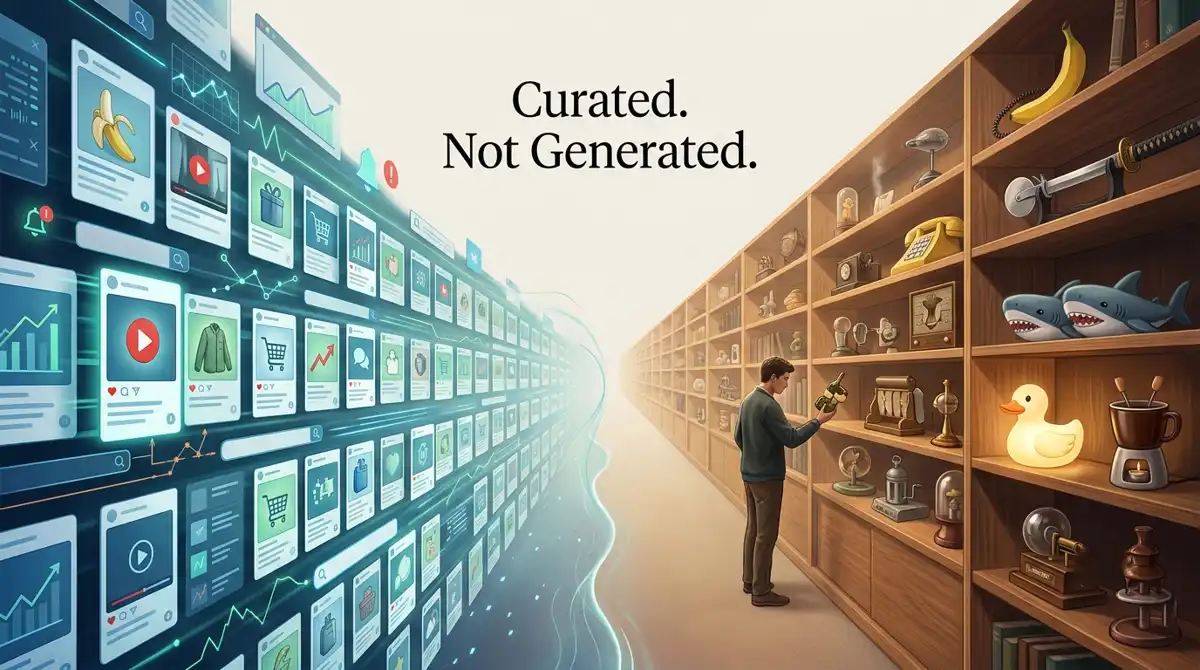
For us, that means treating curation as a creative process rather than an automated feed. It means publishing fewer products with more context, and valuing thoughtful storytelling over endless volume. It also means accepting that trust is earned gradually through consistency, because readers return to editors whose judgment they value long before they become loyal to any particular product.
The strongest discovery websites were never defined by the size of their catalogs. They were defined by the consistency of their editorial judgment. That remains the principle we hope to carry forward as Oddbbo continues to grow.
Why Discovery Still Matters
What the history of weird product websites tells us about the future of curiosity on the internet.
When the earliest weird product websites appeared, the internet looked very different from the one we know today. Search engines were less sophisticated, online shopping was still developing, and discovering something unusual often depended on following links from one website to another. The experience felt slower, less predictable, and in many ways more accidental. People rarely expected every search to produce the perfect answer, which meant that unexpected discoveries became a natural part of exploring the web.
Over the past two decades, that experience has changed dramatically. Search has become remarkably efficient, recommendation systems have learned to anticipate our interests, and social media has turned product discovery into a continuous stream of personalized suggestions. Finding information has become easier than at any point in the history of the internet. Yet this abundance has introduced an unexpected paradox. The more efficiently the web delivers what we are looking for, the fewer opportunities it leaves for us to encounter something we never thought to search for in the first place.
That paradox helps explain why the websites discussed throughout this guide continue to feel relevant. Their purpose has never been to compete with search engines or online marketplaces. Instead, they offer something those systems often struggle to provide: the pleasure of meaningful surprise.
Discovery Is Different from Search
Search begins with intent. We know, or at least believe we know, what we want, and technology helps us reach that destination as quickly as possible. Whether we are comparing headphones, researching travel destinations, or looking for a birthday gift, the objective is efficiency. Good search minimizes effort and removes uncertainty, allowing us to complete a task with as little friction as possible.
Discovery follows an entirely different path. It begins not with certainty but with curiosity, inviting us to explore without a clearly defined destination. The satisfaction comes from encountering ideas we would never have searched for because we did not know they existed. A strangely designed lamp, an ingenious kitchen gadget, or a beautifully impractical invention can become memorable precisely because it interrupts our expectations rather than fulfilling them.
This distinction is easy to overlook because both experiences often happen on the same devices and within the same browsers. Yet they satisfy fundamentally different human instincts. Search helps us solve problems. Discovery expands our sense of what is possible.
Human Curation Creates Connections That Data Alone Cannot
One reason the most successful discovery websites have remained influential is that they rely on a form of editorial thinking that extends beyond simple recommendation. Algorithms excel at identifying patterns in behavior, recognizing that people who purchase one product are statistically likely to be interested in another. That capability has transformed online shopping and will continue to shape how information is organized in the future.
Editorial curation operates according to a different logic. Rather than asking what is most likely to generate another click, human editors ask what deserves attention and why. They notice cultural references, emerging design movements, unusual combinations of ideas, and objects whose significance cannot easily be measured through historical data. More importantly, they create relationships between products that are connected by imagination rather than by purchasing habits.
The websites examined in this guide demonstrate this principle repeatedly. Their collections are memorable not because every product is objectively better than alternatives, but because the products are assembled into a coherent editorial narrative that reflects taste, curiosity, and perspective. Those qualities are difficult to automate because they depend on interpretation rather than prediction.
The Value of Curation Increases as Content Becomes Abundant
Perhaps the most significant lesson from the past decade is that access to information is no longer the internet’s greatest challenge. Product descriptions, customer reviews, buying guides, and comparison articles exist in extraordinary quantities, while artificial intelligence has made it possible to summarize and generate content at unprecedented speed. As information becomes easier to produce, however, its abundance creates a new problem. Readers must decide which voices deserve their attention.
This shift changes the role of editorial websites in important ways. Their primary responsibility is no longer to provide information that cannot be found elsewhere, because almost every factual detail can now be retrieved within seconds. Instead, their value lies in selecting, interpreting, and contextualizing information so that it becomes meaningful. Editorial judgment transforms a collection of unrelated products into a coherent experience, allowing readers to spend less time navigating noise and more time encountering genuinely interesting ideas.
In this environment, thoughtful curation becomes more valuable rather than less. Technology may continue to reduce the cost of creating content, but it does not reduce the importance of deciding which content is worth presenting in the first place.
The Future Belongs to Better Editors, Not Bigger Catalogs
Looking back at every website featured in this guide, one observation remains remarkably consistent. None of them became influential because they offered the largest inventory or published the greatest number of products. Their lasting reputation was built on editorial judgment, on the confidence to publish selectively, and on the ability to recognize ideas that would resonate long before they became mainstream.
That principle seems unlikely to change. The internet will undoubtedly continue to evolve, introducing new technologies, new publishing formats, and new ways of discovering products. Yet the websites that continue to matter will probably be those that help readers see beyond the obvious. They will not attempt to compete with algorithms by becoming faster or larger. Instead, they will distinguish themselves by becoming more thoughtful, more selective, and more recognizably human.
In many respects, the future of discovery does not depend on producing more recommendations. It depends on producing better ones.
A Personal Reflection
Researching the history of weird product websites has changed the way we think about the internet itself. What initially appeared to be a niche devoted to unusual gadgets gradually revealed something much broader: a long tradition of editors, writers, designers, and curious individuals who believed that the web could be a place for exploration as much as efficiency.
That perspective continues to shape the direction of Oddbbo. Our ambition is not to collect every unusual product that exists or to compete with the scale of large marketplaces. Instead, we hope to contribute to the same editorial tradition established by the websites explored throughout this guide, treating curation as a creative practice that rewards attention, encourages curiosity, and occasionally introduces readers to something they never expected to discover.
The products themselves will inevitably change over time. What should remain constant is the experience of finding them.
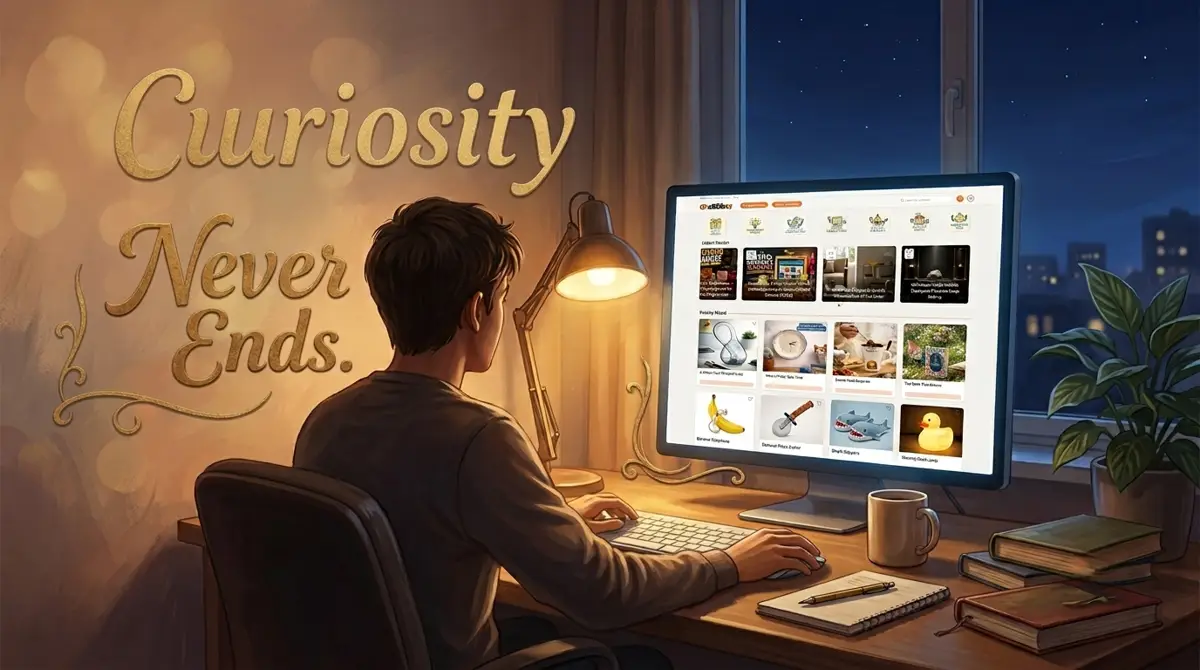
The history of weird product websites is, in many ways, a history of how people choose to explore the internet. Technologies have evolved, business models have shifted, and the methods of finding information have become dramatically more sophisticated. Throughout those changes, however, one simple idea has endured: discovering something unexpected is one of the web’s most satisfying experiences.
That is why these websites continue to matter. They remind us that the value of the internet has never been measured solely by how quickly it answers our questions, but also by how often it inspires new ones. In a digital world increasingly optimized for efficiency, the opportunity to pause, wander, and encounter something genuinely surprising has become not an outdated habit, but a meaningful one.
For us, that is what weird product discovery has always been about. It is less a category of products than a way of looking at the web—with curiosity, with openness, and with the expectation that somewhere beyond the next click there may still be something capable of making us smile and think, “I can’t believe this actually exists.”
A Final Observation
Throughout this guide, one pattern appeared again and again. The weird product websites that people still remember today were rarely the ones with the largest catalogs or the most aggressive publishing schedules. Instead, they were the ones with a recognizable editorial point of view.
That observation feels especially relevant today. As AI makes it easier to generate product lists, summaries, and recommendations at scale, originality becomes harder—not easier—to find. The value of human curation is no longer about collecting more products. It is about recognizing which discoveries are genuinely worth sharing.
Perhaps that is the real legacy of the early weird product websites.
They remind us that curiosity has never depended on endless choice.
It has always depended on thoughtful selection.