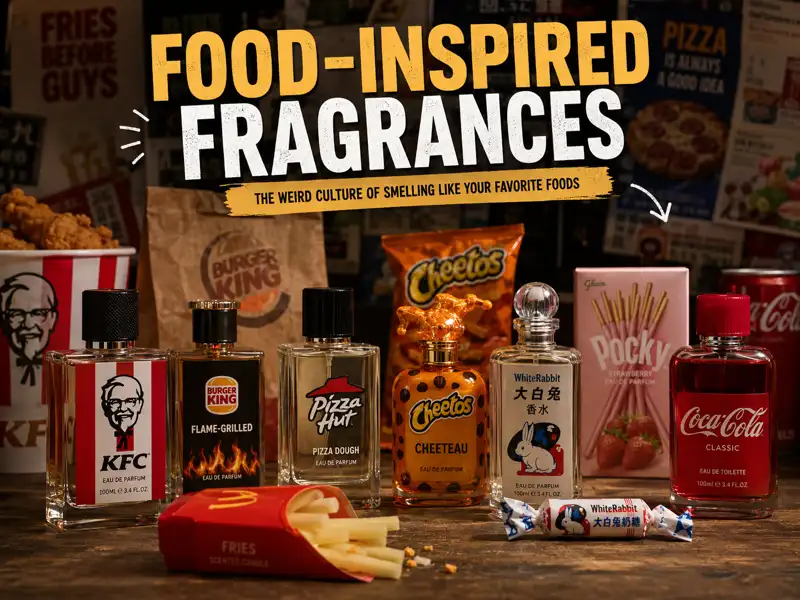
Somewhere on the internet, a serious marketing campaign once asked a question that still feels slightly unreal when you say it out loud:
What if you could smell like fried chicken?
Not metaphorically. Not as a joke concept sketch. But as an actual bottled fragrance, packaged and promoted like any other perfume, complete with campaign photos and people online debating whether they would ever, under any circumstances, wear it.
That moment is usually where most people first stumble into the world of weird food perfumes. And once you notice it, you start seeing it everywhere — pizza perfume concepts, burger scented fragrance experiments, candy-inspired scents, soda fragrances, even luxury perfumes that quietly borrow the emotional language of desserts and bakery air.
It doesn’t feel like a normal product category. It feels more like an internet artifact that keeps regenerating itself in different forms.
And yet, it’s real.
Fast Food Fragrances: When Restaurants Started Bottling Their Identity
Fast food brands have always understood attention. But in the age of social media, attention itself became the product — and fragrance turned out to be one of the strangest ways to capture it.
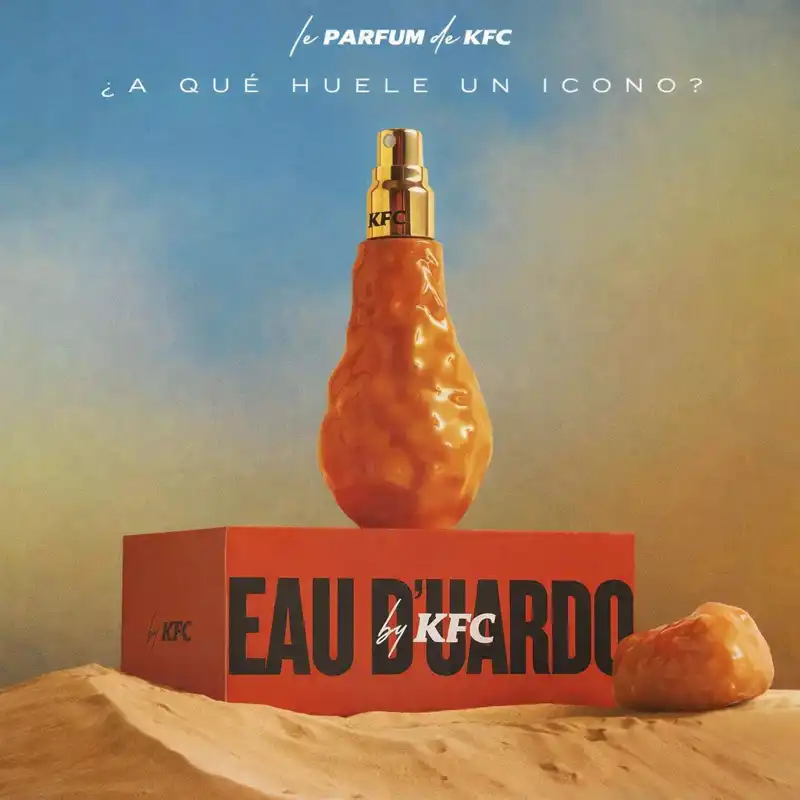
One of the most widely shared examples is the KFC Eau Duardo fragrance, a limited novelty perfume inspired by fried chicken seasoning, herbs, and that unmistakable crispy-skin aroma people recognize instantly even through memory alone.
On paper, it sounds like a joke product. But culturally, it works because it collapses two worlds that rarely meet: comfort food and personal scent. Fast food already lives in memory — late nights, road trips, cheap meals shared with friends — so turning it into fragrance feels oddly logical in a way that bypasses rational judgment.
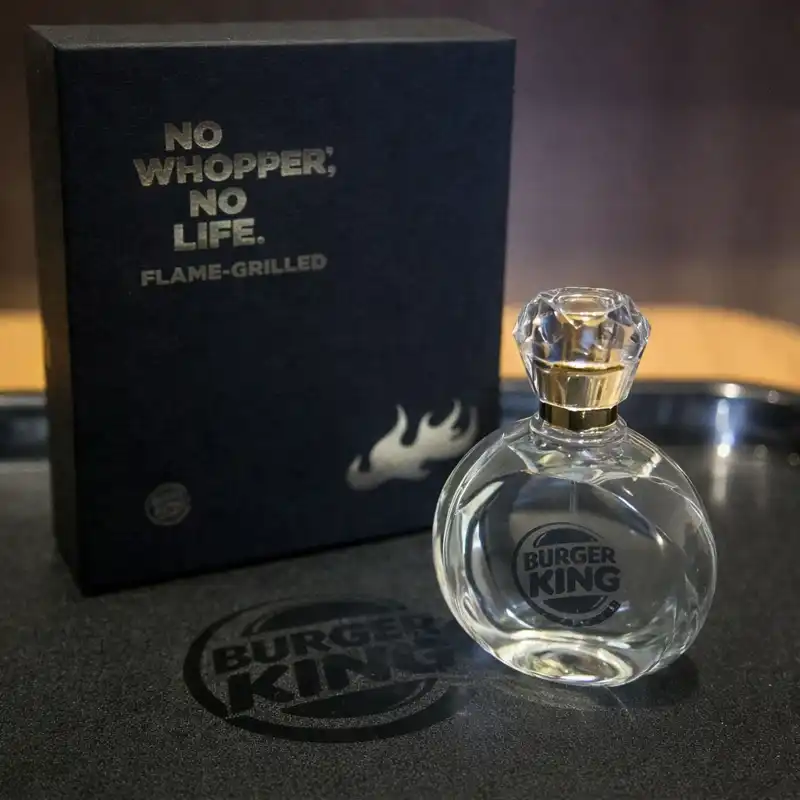
This is also why campaigns like Burger King Flame-Grilled fragrance gained traction. The idea wasn’t just “burger smell in a bottle,” but an exaggerated sensory identity built around smoke, grill heat, and fast-food intensity — a burger scented fragrance designed less for daily wear and more for internet visibility.
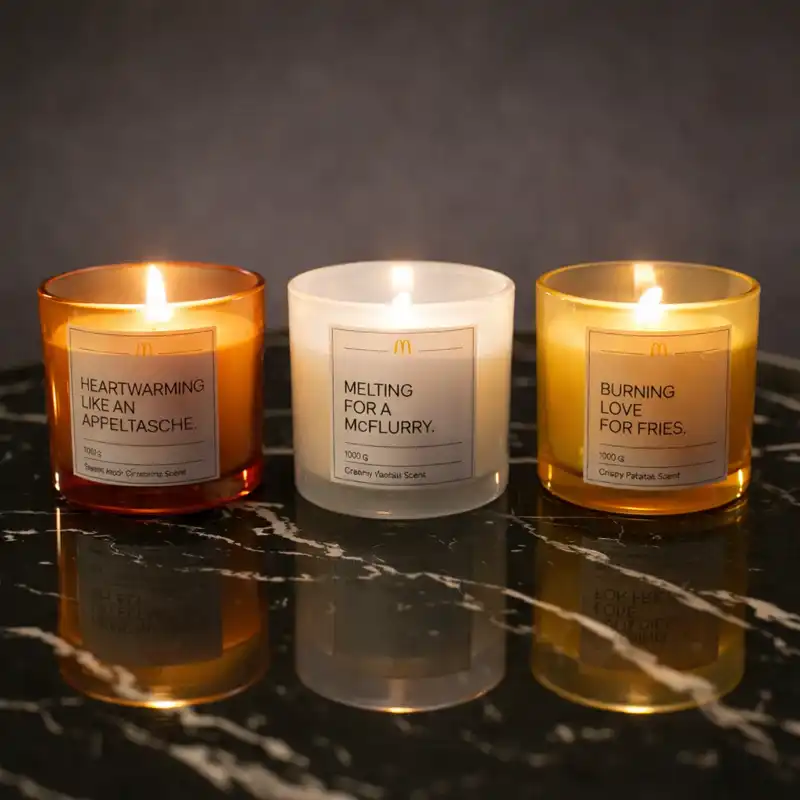
And then there are smaller, almost myth-like experiments such as McDonald’s fries scented candles, which translate a very specific smell — hot oil, salt, cardboard warmth — into home fragrance objects that sit somewhere between novelty decor and sensory nostalgia.
None of these products exist purely as “perfume.” They exist as attention events. The scent is almost secondary. What matters is the reaction: confusion, amusement, disbelief, and the immediate instinct to share it online.
Fast food fragrances work because they feel like something the internet invented — even when brands are the ones producing them.
Search ‘food-inspired perfume’ on Amazon and you’ll find similar experimental scents.
Snack & Candy Inspired Scents: When Nostalgia Becomes a Smell
If fast food perfumes are about shock value, snack-based fragrances are about something quieter and more emotionally complicated.
Take Cheetos Cheeteau perfume, a playful interpretation of the iconic cheesy snack aroma turned into a novelty fragrance concept that instantly divides people into two groups: those who laugh, and those who are secretly curious.
Then there are softer, more nostalgic interpretations like White Rabbit milk candy perfume, which transforms a childhood sweet into a creamy, powdery scent memory. Unlike fast food fragrances, this category isn’t trying to be funny — it’s trying to be emotionally recognizable.
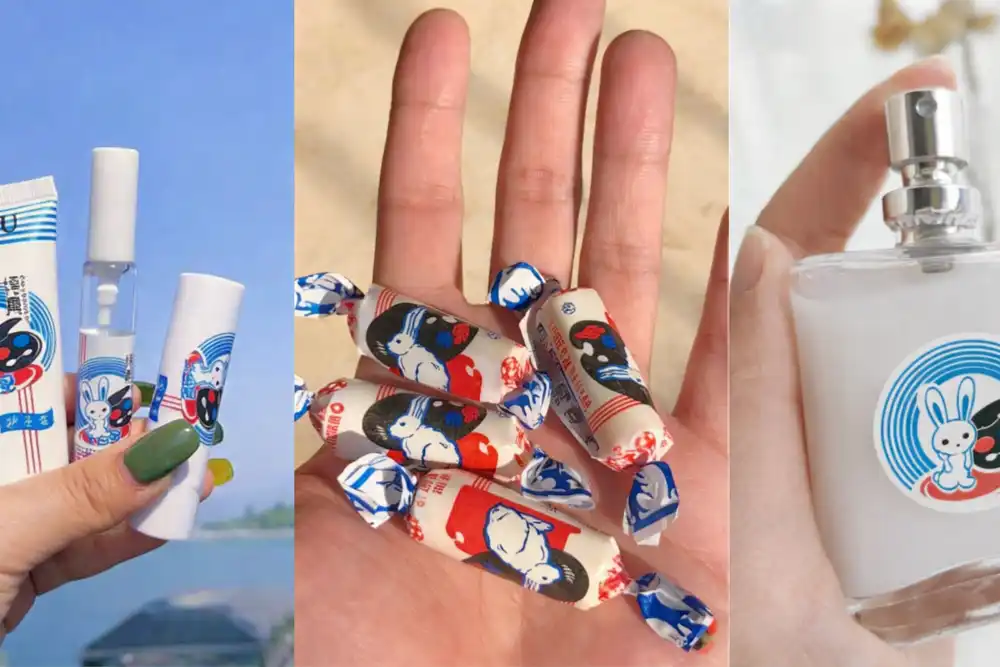
The same idea appears in Pocky-inspired fragrances, where chocolate-dipped biscuit sticks become a reference point for playful, slightly youthful sweetness tied to pop culture rather than culinary realism.
These products exist because scent is one of the strongest memory triggers humans have. A smell doesn’t just remind you of something — it briefly places you back inside it. Snack-inspired fragrances lean heavily into that effect, turning nostalgia into something you can technically wear.
You can still find similar novelty scents circulating through niche fragrance communities and online marketplaces, especially where collectors trade limited or experimental releases.
Luxury / Artistic Food Perfumes: When High-End Fragrance Borrowed the Same Idea
What started as internet jokes gradually began influencing luxury fragrance language.
At some point, what started as internet novelty began appearing in luxury fragrance houses — just in a more poetic form.
Instead of “smelling like pizza,” the language became “warm dough accord.” Instead of “candy perfume,” it became “soft gourmand memory.”
One example is Maison Margiela Afternoon Delight, a fragrance that leans into creamy, bakery-like warmth, evoking desserts and slow afternoons rather than literal food references.
Another is Diptyque L’Eau Papier, which, while not a food fragrance in a literal sense, plays in the same sensory space — soft warmth, subtle texture, and memory-driven abstraction that feels strangely edible even when it isn’t.
What’s interesting here is not imitation, but convergence. Luxury perfumery arrived at similar emotional territory as internet novelty products, just through a different vocabulary.
Both are trying to do the same thing: translate memory into smell.
The difference is that one speaks in meme culture, while the other speaks in metaphor.
Nostalgia-Based Fragrances: Soda, Candy, and the Smell of Artificial Memory
Some of the most fascinating entries in food-inspired fragrances come from drinks and artificial flavors — especially Coca-Cola and Fanta inspired scents.
Unlike real food smells, soda fragrances are built on something more abstract: branding memory. Nobody encounters “cola scent” in nature. It exists entirely as a manufactured sensory identity reinforced through advertising, packaging, and repetition.
Yet it feels instantly recognizable.
That’s what makes it powerful.
These fragrances don’t just replicate smell — they replicate cultural memory. A cola scent isn’t just soda. It’s cinemas, vending machines, summer heat, convenience stores at night, and the slightly artificial sweetness of childhood experiences that were never fully analyzed, only absorbed.
This is where food-inspired fragrances become more than novelty. They start functioning as emotional reconstruction tools.
They don’t smell like reality. They smell like remembered reality.
And in many cases, that’s even more compelling.
Where These Fragrances Actually Exist Today
While some of the most viral food perfumes started as limited campaigns, the idea never really disappeared. It simply spread into different corners of consumer culture.
Today, weird food perfumes and novelty scent products are still thriving. A quick search for “gourmand novelty perfume” reveals an entire world of brands continuing to experiment with edible-inspired scents.
- Amazon novelty perfume listings, where experimental and humorous fragrance concepts continue to circulate in small batches
- Niche fragrance brands that explore gourmand scent profiles more seriously, often blurring the line between dessert inspiration and wearable art
- Candle and home scent markets, where “food atmosphere” products like bakery, coffee, and fast food-inspired candles appear regularly
- Independent creators experimenting with small-batch fragrance oils inspired by snacks, drinks, and pop culture references
In practice, this means pizza perfume concepts, burger scented fragrance ideas, and even KFC cologne-style novelties don’t disappear — they evolve, resurface, and reappear under new branding or limited releases.
Some are collectible. Some are jokes. Some are surprisingly well-crafted scent experiments that never expected mainstream attention.
But all of them exist in the same ecosystem of curiosity-driven consumption.
Why Food Perfumes Became a Search Trend
Over time, terms like ‘KFC cologne’ and ‘pizza perfume’ quietly became recurring internet search trends. Part of the reason people keep searching for things like KFC cologne or pizza perfume is that these products don’t feel entirely real when you first hear about them. They sound like the kind of fake screenshots that circulate online for a few hours before someone reveals the joke. But then you realize the fragrance actually existed, complete with packaging, campaign photos, and people seriously discussing what it smelled like.
Many weird food perfumes survive online not because people plan to buy them, but because the concepts themselves generate endless curiosity clicks.
That moment of uncertainty is powerful on the internet.
Modern online culture is built around curiosity almost as much as information. People click because they want to resolve a tiny mental contradiction. A luxury perfume makes immediate sense. Fried chicken perfume does not. The brain wants to investigate the gap between those two ideas.
That’s why weird food perfumes spread so naturally through social media. They are visually simple, instantly understandable, and slightly absurd in a way that encourages sharing. Someone posts a burger scented fragrance or a novelty perfume inspired by french fries, and the comments immediately fill with the same mix of reactions: disbelief, amusement, confusion, and low-level curiosity.
But beneath the meme factor, there’s usually something more recognizable happening.
Food scents are tied unusually closely to memory. Even people laughing at pizza perfume already understand the emotional reference behind it — late-night takeout, parties, comfort food, childhood snacks, road trips, movie nights. These fragrances succeed online because they combine irony with familiarity. They feel strange enough to become content, yet familiar enough to trigger genuine emotional recognition.
That balance keeps the category alive.
The internet constantly rediscovers unusual fragrance concepts because they work almost perfectly as curiosity objects. You don’t need to buy them to become fascinated by them. Just imagining what they smell like is already part of the experience. And once a product successfully makes people imagine the impossible — smelling like pizza, burgers, or fried chicken — the internet rarely lets it disappear completely.
The Internet’s Obsession With Food as Scent
The deeper reason this entire category keeps returning has less to do with fragrance and more to do with how the internet behaves.
Meme culture rewards anything that feels instantly explainable yet slightly unbelievable. “Smelling like fries” fits that pattern perfectly. It is simple enough to understand in a second, but strange enough to make people pause.
At the same time, scent is uniquely powerful in a way digital content can’t fully replicate. You can describe it, show it, joke about it — but you can’t experience it through a screen. That gap forces imagination, and imagination drives engagement.
There’s also nostalgia marketing at play. Food smells are tightly linked to memory, and brands know this. A pizza dough fragrance doesn’t really sell pizza — it sells the emotional texture of shared meals, late nights, and comfort routines.
Over time, novelty perfume culture became a meeting point for all of this: meme logic, emotional branding, scent memory psychology, and the modern obsession with products that feel like internet discoveries rather than traditional goods.
That’s why weird food perfumes keep returning in cycles. They are not just products. They are small cultural events designed to be noticed.
Related Curiosities
If food-inspired fragrances feel unusual, they are actually part of a much wider pattern where everyday sensory experiences are being turned into objects of curiosity.
Fast food-inspired fragrances like KFC cologne or pizza perfume sit in the same universe as snack-themed scents, artificial nostalgia products, and limited-edition novelty perfumes designed more for internet attention than traditional wear.
Other related curiosities include:
- Fast food branding that expands into unexpected sensory products like fragrance and candles
- “Artificial nostalgia” items inspired by discontinued snacks, drinks, and childhood food memories
- Internet-famous home scents that recreate places rather than ingredients
- Novelty beauty products shaped like everyday objects, designed for visual shock and shareability
- Meme-driven products that exist primarily to circulate on social media before they are ever used
Each of these ideas exists in the same space: where consumer products stop being just functional objects and become shared cultural references.
And once you notice it, it becomes almost impossible to ignore.
Because somewhere right now, another fragrance is probably being developed — one that tries to bottle a memory, a joke, or a feeling that was never meant to be captured in scent at all.
And the internet will do what it always does:
Treat it as strange… until it becomes normal.